
Care at Capo Canyon — San Juan Capistrano
Capo Canyon’s small residential program in San Juan Capistrano
Capo Canyon provides alcohol and drug treatment in San Juan Capistrano, California, with medical detoxification and residential care in a small, private setting. The current website specifically addresses executives and other professionals who need treatment while managing concerns about privacy and essential responsibilities. Its residential page states a maximum of five clients, and the current accommodation description promises private bedrooms. The clinical program includes individual therapy, group work, psychiatric care, and attention to co-occurring mental health concerns. The setting and practical policies are distinctive, but suitability still depends on the individual’s clinical assessment.
The provider’s emphasis on professional life does not mean that treatment is simply a remote-working retreat. Capo Canyon describes a structured program with medical and therapeutic priorities, while allowing phones and laptops under its technology policy. Someone considering admission should clarify how essential communication fits around sessions and the initial stabilization period. The relevant question is whether the actual schedule allows the person to engage meaningfully with treatment, not whether the presence of Wi-Fi makes it possible to continue every usual responsibility without adjustment.
Detoxification and the move into residential care
Capo Canyon advertises detoxification with nursing care on site around the clock and psychiatric involvement in assessment and stabilization. Its current homepage describes detox-only stays as generally seven to ten days, followed where appropriate by residential treatment. These are published planning ranges rather than a fixed medical timetable. The admitting clinicians need to review substance use, medications, physical health, and any recent treatment before confirming the appropriate setting. A person should not assume that every withdrawal situation can be managed in a small residential facility simply because detox is advertised.
The residential page explains that fuller programming begins once the person is medically stable and cleared to participate. This distinction helps separate early withdrawal support from the longer work of therapy, recovery planning, and addressing mental health concerns. A written admission proposal should identify whether detox and residential treatment form one planned course or separate phases with different charges and authorizations. It should also explain what happens if the clinical team recommends transfer to a more medically intensive setting or a different level of care.
Clinical assessment and co-occurring conditions
The provider describes a multidisciplinary assessment of medical, psychological, and therapeutic needs. Its primary focus is alcohol and drug treatment, including co-occurring concerns such as trauma, anxiety, and depression. That is different from assuming every primary psychiatric condition is appropriate for this campus. Someone whose main need is psychiatric stabilization, with little or no substance use component, should clarify the program’s admission scope. The clinical team needs enough information to determine whether Capo Canyon can address the person’s actual presentation and what additional support may be necessary.
Individualized planning is a recurring part of the official description. The residential page identifies a primary therapist, psychiatric services, trauma-informed care, and a range of therapeutic methods. This provides a framework for coordinated treatment, but the details should be specific enough to assess before admission. A prospective resident can ask how frequently the plan is reviewed, who manages existing prescriptions, and which professionals will be involved. The directory does not infer staffing ratios or a particular level of psychiatric availability beyond what the provider explicitly publishes.
Individual therapy, group work, and treatment methods
Cognitive behavioral therapy and dialectical behavior therapy are prominently named on the current homepage. The private-treatment page additionally advertises EMDR and other individualized clinical work. These methods should be connected to the person’s assessed needs rather than treated as a checklist that every resident must complete. The website also describes group therapy, addiction education, relapse prevention, and aftercare planning. A small resident census may shape the experience of group work, but the number of people in the house does not itself establish a particular therapy outcome or guarantee a fixed amount of clinician time.
The provider’s current pages describe individual contact in slightly different ways. The homepage promises at least four weekly individual sessions across the therapist, case manager, and psychiatry team, while the private-treatment page describes at least four meetings with a primary therapist. Because those are not identical commitments, the agreed schedule should be clarified in the admission proposal. This profile reports the general emphasis on frequent individual contact without treating the broader team-contact figure as four guaranteed psychotherapy appointments for every resident.
Recovery approaches and personal preferences
Capo Canyon’s residential page advertises non-twelve-step and alternative options while also describing an introduction to twelve-step recovery among possible program elements. This suggests a range of approaches rather than a clearly stated requirement that every resident follow one recovery framework. Someone with strong preferences or prior experience should discuss how the program would be tailored. The important detail is the actual clinical and peer-support plan, including which activities are expected and which are optional, rather than a broad label attached to the entire facility.
Relapse prevention and preparation for life after treatment are part of the stated residential approach. For a professional resident, this may involve considering work-related stress, travel, communication demands, or situations connected with substance use. Those are topics to address within the individual plan, not assumptions that every executive has the same triggers or needs. A workable approach should reflect the person’s role, relationships, health, and resources, with enough time in treatment to develop practical changes rather than simply resume the previous schedule from a different location.
Private rooms and the daily environment
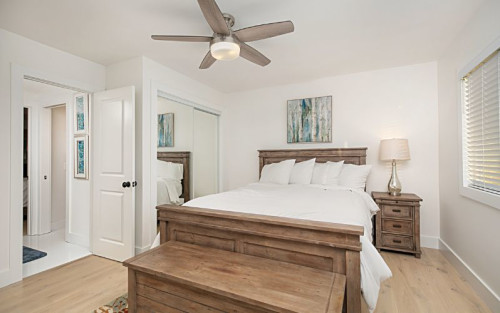
The current official accommodation description is specific: bedrooms are private and include a desk, television, Wi-Fi, and bedding. The provider also advertises chef-prepared meals, an organic garden, and menus that can take dietary needs into account. These details may matter to someone who needs personal space or has concerns about shared accommodation. Room availability, accessibility, bathroom arrangements, and any relevant dietary restrictions should still be confirmed for the offered placement. A private bedroom does not automatically establish every other accommodation feature or an unrestricted ability to work in the room.
Published wellness amenities include exercise facilities, personal training, yoga, meditation, massage, and outdoor gathering areas. The residential page also mentions acupuncture. These are advertised additions to the clinical program, and their timing, suitability, and inclusion in the fee should be checked individually. The provider’s longer private-treatment page lists further experiential options, but this directory does not treat every item as a guaranteed activity in every stay. The practical value lies in what is available and appropriate for the resident during the actual admission period.
Phones, laptops, and professional responsibilities
Capo Canyon explicitly allows phones and laptops, which is a meaningful difference from programs with a complete device restriction. Its current pages are less consistent about the exact hours of use, so an individual should obtain the current policy rather than assume unlimited access during therapy. Essential calls, accessibility needs, family communication, and work-related obligations can be discussed during planning. The agreed arrangement should protect time for treatment and account for any restrictions during medical stabilization or periods when the clinical team recommends greater focus.
The provider presents itself as a discreet setting for professionals, but a general privacy statement is not a guarantee that no information will ever need to be shared for a legitimate purpose. Insurance administration, medical coordination, or a resident’s own request for documentation may involve specific disclosures. Prospective clients can ask how those processes are handled and what authorizations are required. The directory does not repeat marketing language suggesting that professional consequences can always be avoided or that a treatment program controls an employer’s policies.
Duration and continuing care
The current homepage describes residential stays of roughly two to four weeks after stabilization, with detox-only admissions generally lasting seven to ten days. It also says some clients continue with aftercare for a period of months. These are separate stages and should not be combined into one assumed package. The recommended duration needs to reflect clinical needs, response to treatment, and the practical plan afterward. A short available window for leave does not by itself establish that the same length is clinically appropriate.
Capo Canyon describes identifying next steps and continuing resources during residential care. That work can include deciding whether outpatient treatment, ongoing therapy, psychiatric follow-up, or chosen recovery meetings are needed after discharge. The public pages do not establish that every aftercare service occurs at the same residence or is included in the base charge. Someone returning to another region should clarify who will provide continuing treatment there, how records will be transferred with consent, and which appointments have actually been arranged.
Cost and arranging an admission
Recovery.com lists an estimated cash-pay rate of $1,300 per day for residential treatment or detoxification at Capo Canyon. This is a third-party estimate, not an official fixed tariff. It should not be assumed to cover every psychiatric consultation, optional wellness service, transport arrangement, or extended aftercare plan. The provider offers insurance verification and private-pay options, but a broad statement that coverage may be available is not a guarantee of payment under a particular policy. A written estimate should distinguish the expected total charge from the resident’s responsibility after benefits review.
The current official contact number is +1 949-382-1100. Admissions can clarify the clinical recommendation, available room, current device policy, weekly individual-contact schedule, and services included in the proposal. Those details make it possible to compare the small-campus model with other options on a consistent basis. Readers considering Southern California can explore the directory’s United States treatment destinations and California treatment guide. The most relevant comparison is the care that will actually be provided for the person seeking admission.
Sources and verification
Reviewed October 20, 2026: Capo Canyon’s current overview; residential program; private treatment and accommodation; and Recovery.com’s estimated daily price. Differences between official descriptions of individual-session frequency and device hours are left for explicit admission confirmation.
Conditions
Levels of care
Settings
Amenities
Treatment approach
CBT, DBT, individual and group therapy, psychiatry, trauma-informed care, advertised EMDR, alternative recovery options, case management and continuing-care planning
Fees & admissions
USD 1,300 / day
Recovery.com estimated USD 1,300 per residential or detox day, checked October 20, 2026. This is a third-party estimate, not a provider tariff; confirm medical charges, optional services, transport, aftercare and actual insurance benefits.
Confirm the current program, duration, accommodation and included services directly with the center.
Confirm a 30-day residential admission is clinically available, whether the daily rate remains constant, detox fees, room type, technology rules and aftercare arrangements.