
Care at Camelback Recovery Residential — Peoria
Camelback Recovery’s Peoria residential center
Camelback Recovery provides residential addiction and mental health treatment at 9312 West Happy Valley Road in Peoria, Arizona. The current official description identifies a private home in north Peoria with clinical support around the clock. Adults can receive care for substance use, a primary mental health condition, or both. This is distinct from the organization’s Phoenix outpatient clinic, where daytime and outpatient services are delivered. The distinction matters when arranging admission, comparing treatment levels, or checking whether a particular service takes place at the residence.
The Peoria program describes stays that commonly last 30 to 90 days, with the duration guided by the clinical plan and progress. Its approach combines psychiatric care, individual and group therapy, family involvement where appropriate, and a structured daily routine. The provider also offers a pathway into partial hospitalization, intensive outpatient care, and longer-term support. Those later stages are separate services rather than an automatic extension of the same residential room or a guarantee that every person follows an identical sequence.
Addiction, primary mental health, and dual diagnosis
The current Peoria page explicitly includes residential mental health treatment as well as addiction care. Named mental health concerns include depression, anxiety, bipolar disorder, post-traumatic stress and trauma, obsessive-compulsive concerns, and personality disorders. The addiction program describes treatment for alcohol, opioids, fentanyl, stimulants, benzodiazepines, and other substances. These are advertised areas of care, not confirmation that every presentation or severity level can be managed at this residence. The admitting team needs to assess the individual’s symptoms, medical needs, functioning, and appropriate level of support.
For people with both substance use and mental health concerns, Camelback describes one coordinated treatment plan. This can help connect therapy, psychiatric review, and recovery planning rather than addressing each concern in isolation. A person with an existing psychiatrist, therapist, or recent hospital admission should provide the relevant information during intake. The directory does not interpret the provider’s broad scope as a replacement for emergency medical care or a guarantee that every complex psychiatric situation is appropriate for a non-hospital residential setting.
Assessment and the first stage of care
The provider’s Peoria description says that a clinical team member introduces the resident to the house, schedule, and treatment plan, with psychiatric assessment at the start of care. The wider inpatient material describes reviewing substance use history, current symptoms, physical health, previous treatment, family circumstances, and goals. These details help determine what support is needed rather than simply assigning a standard program based on a directory category. The initial plan should also identify any outside medical coordination and how existing prescriptions will be reviewed.
Camelback advertises detoxification within its broader continuum, but the addiction-treatment page explains that some people need a specialized detox step before residential treatment. The exact sequence and location should therefore be established during assessment. A prospective resident should not assume that the Peoria room is the first destination in every case or that any possible withdrawal need is included in a single quoted package. The admission team should identify the appropriate initial care, any transfer arrangements, and the clinical handover between stages.
Therapy and psychiatric support
The current Peoria page names cognitive behavioral therapy, dialectical behavior therapy, EMDR, and acceptance and commitment therapy, with individual, group, and family sessions. These methods form the advertised clinical approach, while the individual plan determines which are appropriate. The provider states that residents typically meet with a therapist one to two times per week and participate in small therapy groups during the week. That is more precise than assuming that a small residence provides daily private psychotherapy to every client.
Psychiatric care includes medication management and review as the person stabilizes. A resident can clarify who will prescribe during the stay, how often reviews are expected, and how information will be shared with existing clinicians when authorized. The public description does not establish that a particular medication will be started or stopped. Similarly, the availability of EMDR or another specialized therapy is not a guarantee that it will be appropriate at the beginning of admission or included at a fixed frequency for every resident.
A home environment with shared and private room options
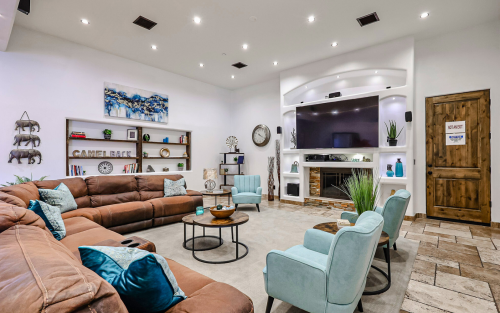
Camelback describes the Peoria residence as a small home with a published capacity range of six to fifteen beds. The range should not be converted into a precise current occupancy or staff-to-client ratio. The official accommodation information says shared bedrooms are standard, while private rooms and en-suite bathrooms may be available. That distinction updates any impression that every resident automatically receives a private suite. The actual room, occupancy, bathroom arrangement, accessibility, and any additional charge should be confirmed for the offered placement.
The provider advertises chef-prepared meals with support from a registered dietitian, a swimming pool, fitness space, an outdoor sports court, gardens, and walking areas. These details describe the environment in which treatment takes place. They do not establish that every activity is appropriate for every resident or available without restrictions throughout the stay. Dietary needs, mobility limitations, allergies, and any support required for daily living should be discussed before arrival so that the practical arrangements match the person’s needs.
Wellness activities, phones, and family visits
The current Peoria description includes yoga, breathwork, mindfulness, equine therapy involving rescue horses, chiropractic care, and other integrative wellness activities. These are advertised components of the wider schedule alongside clinical treatment. A resident can ask which activities are currently offered, how participation is adapted, and whether any services require separate consent or payment. The directory does not infer that equine work means riding or that a particular wellness activity produces a guaranteed mental health benefit. The appropriate role of each activity should be clear within the individual plan.
Phone access and family visits are subject to clinical approval. The homepage additionally says phones are used outside group sessions once the treatment team approves access. These are practical limits worth discussing before admission, especially for someone with caregiving responsibilities or essential communication needs. Family therapy is included in many treatment plans, but a visit is not automatically a clinical session. Relatives can clarify the timing, format, and consent arrangements for participation, including what is possible if they live outside Arizona.
The separate Phoenix outpatient clinic
Camelback’s current website places partial hospitalization, intensive outpatient treatment, outpatient mental health care, psychiatry, and transcranial magnetic stimulation at its Phoenix clinic, 4527 North Sixteenth Street, Suite 200. These services should not be presented as though every one is delivered inside the Peoria residence. The organization describes continuity with the same clinical team as a person moves between levels, but the physical location and living arrangements change. An individual transition proposal should identify the actual schedule, transportation, and housing plan.
The provider also advertises an evening telehealth intensive outpatient program for Arizona residents. That may be relevant later in the pathway, but eligibility and clinical suitability still need to be confirmed. A virtual program does not provide the overnight environment of residential treatment. Likewise, a separate sober-living placement has a different role from the clinical residence. Understanding those distinctions helps a person compare the support available at each stage and avoid assuming that all services in the wider organization are included in one residential fee.
Planning the transition beyond Peoria
The published continuum moves from Peoria residence into daytime or outpatient treatment, then ongoing outpatient support, sober living where appropriate, and alumni connections. The provider emphasizes planning for this transition before residential discharge. For someone returning to another state, continuing care may need to involve local clinicians rather than the Phoenix clinic. A useful plan identifies appointments, prescriptions, accommodation, transportation, and chosen recovery supports, with the resident’s consent for necessary communication between providers.
Camelback’s alumni description includes meetings, social activities, and continuing accountability connections. These may provide a familiar community after more intensive treatment ends, but they do not replace therapy or psychiatric follow-up when those are recommended. The level of ongoing support should reflect the person’s actual needs and preferences. A resident can clarify which alumni activities are available remotely and which require attendance in the Phoenix area, particularly if the planned discharge destination makes frequent local participation impractical.
The provider’s conditional re-treatment offer
Camelback advertises a Continuum of Care Treatment Guarantee with specific conditions. The published outline requires at least 30 consecutive days of inpatient care, 30 partial-hospitalization sessions, and 30 intensive-outpatient sessions, with abstinence during those phases and active alumni participation afterward. If qualifying clients experience recurrence within one year of IOP discharge, the provider describes up to 60 days of clinically appropriate re-treatment without an additional charge. Clinical leadership determines eligibility and the appropriate service, and a waiting list may apply if no bed is available.
This offer is a conditional service policy, not a promise that treatment prevents relapse or that every former resident receives automatic readmission. A person considering it should obtain the current written terms and understand what participation, eligibility, and available capacity mean in practice. The policy also does not determine the clinically appropriate length of the initial admission. Completing particular program stages for an offer should not be confused with an individualized treatment recommendation or assumed insurance authorization for those stages.
Fees, insurance, and arranging a visit
Recovery.com lists an estimated residential cash-pay price of $49,500. The visible price entry does not attach a specific number of days to that figure, so the directory does not present it as a verified monthly rate. Camelback’s official site offers benefits verification and says costs depend on care level, duration, and coverage. It states that Medicare and Medicaid, including Arizona’s AHCCCS program, are not accepted. A written proposal should separate the residential charge from subsequent outpatient care, housing, optional services, and the resident’s responsibility after insurance review.
The current official contact number is +1 602-466-9880. The provider offers tours by appointment and assistance with travel planning. Before arranging arrival, confirm the recommended initial service, the Peoria room offered, any preliminary detox pathway, and the proposed transition afterward. Readers comparing the region can explore United States treatment destinations and the directory’s Arizona treatment guide. Compare the specific clinical plan and living arrangements, including the difference between the Peoria residence and Phoenix outpatient services.
Sources and verification
Reviewed October 20, 2026: Peoria residence; current locations, policies, and conditional re-treatment offer; addiction treatment pathway; mental health treatment; and Recovery.com’s estimated residential fee. The fee period is not specified in the visible third-party price entry.
Conditions
Levels of care
Settings
Amenities
Treatment approach
CBT, DBT, EMDR, ACT, one to two typical weekly individual sessions, groups, psychiatric medication management, family work, wellness activities and coordinated step-down care
Fees & admissions
USD 49,500 / program
Recovery.com displays an estimated USD 49,500 for residential care, checked October 20, 2026, but its visible price entry specifies no duration. This is not a verified monthly tariff. Confirm included days, room, detox, later outpatient/housing charges and benefits. Provider does not accept Medicare or Medicaid/AHCCCS.
Confirm the current program, duration, accommodation and included services directly with the center.
Request the exact duration attached to the $49,500 estimate, confirm room type, whether advanced psychiatric services cost extra, detox arrangements and the post-residential plan.