
Care at The Sanctuary Oceanic — Private Yacht Program
The Sanctuary Oceanic arranges individualized treatment and wellness programs aboard privately chartered yachts. The provider’s current website describes Mediterranean and Caribbean itineraries, with a selected vessel, a personal treatment team, and a schedule shaped around the client. This is a mobile program, not an identified fixed treatment campus in Monte Carlo. The embarkation point, route, medical arrangements, and accommodation need to be established for each proposed stay. A Monaco label alone does not establish where care will be delivered or which clinical services will be available.
The program combines private accommodation with one-to-one psychotherapy, medical assessment when indicated, physical rehabilitation or fitness support, nutrition, and complementary practices. The Sanctuary Oceanic is part of The Sanctuary World and describes collaboration with yacht specialist Y.CO and medical-support organization MedAire. Those relationships help explain the service model, but they do not replace confirmation of the actual clinicians, vessel, and arrangements for an individual voyage. The central decision is whether the proposed program can meet the person’s care needs within a maritime setting.
What the program offers and where its limits matter
The official conditions page advertises programs for substance use, anxiety, depression, chronic pain, executive stress, postoperative recovery, and other health concerns. It also describes complex medical management. That broad menu should be read alongside its explicit exclusion: the complex medical program is not suitable for someone who needs hospitalization or is in an acute phase of their condition. Availability is determined through assessment, rather than by selecting a destination and assuming every advertised service can be provided there.
For substance-related care, the provider says detoxification may take place before arrival. It also advertises a separate medically supervised detox program for people assessed as suitable. This does not establish that any withdrawal can be managed aboard any yacht. The accepting clinician should explain the proposed setting, monitoring, medication arrangements, and criteria for shore-based care. A therapeutic voyage requires a clear escalation plan, particularly when the nearest suitable hospital may change as the itinerary progresses.
A coordinated team and an individual schedule
The program description says care is delivered individually, without therapy groups. A typical assigned team is described as approximately 12 to 15 therapists and personal staff across roles such as doctors, nurses, psychotherapists, bodywork practitioners, fitness professionals, carers, and chefs. That number refers to the combined team; it should not be interpreted as 12 to 15 clinicians continuously aboard. The staffing proposal should distinguish scheduled visits, remote consultations, resident staff, and clinical cover at different times.
The care plan is finalized after practitioners spend time with the client and assess their needs. The provider describes frequent team communication and adjustments as the program develops. This is a useful feature to examine in practical terms: who coordinates the plan, how feedback from different practitioners is shared, and how the client participates in changes. A coordinated schedule should make the purpose of each appointment understandable, rather than simply assembling a large number of unrelated treatments.
The sample itinerary balances therapy with activities and rest. It includes yoga or meditation in the morning, a possible acupuncture appointment, time exploring a destination, psychotherapy later in the day, and adapted exercise or water activities. Evening time is quieter. The website makes clear that weather, location, and clinical needs can alter the day. Activities in that example are not guaranteed inclusions, and a sample schedule does not establish a fixed daily number of psychotherapy hours.
Psychological work and physical care
Psychotherapy is a central part of the advertised model. The provider describes exploring recurring behavior, relationships, emotional difficulties, and the reasons a person has relied on unhelpful coping patterns. Its anxiety material specifically names cognitive behavioral work, graded exposure, problem solving, relaxation techniques, and supportive psychotherapy. The exact method should follow the person’s assessment and preferences. The program’s one-to-one format may appeal to someone seeking privacy, but the reviewed information does not prove that this format produces better outcomes than other appropriate treatment formats.
The therapies page also discusses physiotherapy, exercise physiology, dietetic input, and specialist medical consultation. A physiotherapist may assess pain or movement restrictions before exercises are selected, while exercise-related work is intended to be adapted to current capacity. Those roles are relevant to a program that may also involve swimming, walking ashore, or other physical activities. A client recovering from surgery or living with a chronic condition should have the activities and vessel layout assessed against their individual restrictions.
Complementary options include massage, Shiatsu, acupuncture, yoga, meditation, Qigong, and creative activities such as music, art, and writing. These are described as parts of an integrated program, not a requirement that every guest use every modality. The treating team should explain which elements address a defined clinical goal and which provide recreation, comfort, or relaxation. The presence of a broad wellness menu is not, by itself, evidence of effectiveness for a specific psychiatric or substance-use disorder.
Clinical leadership and support aboard
The published team includes Nicholas Russi as international clinical program consultant, Dr. Carlos Nuñez as director of psychiatric services, and Dr. Charlie Easmon as director of medical services. It also lists psychiatrist Dr. Leon van Huyssteen and psychotherapist and case manager Dr. Shahar Rabi. These are provider-published roles and biographies. They do not establish that each person will attend a particular voyage or hold the same authorization to practice in every jurisdiction on its route.
The therapies page says a personal doctor and registered nursing staff can be aboard as required. The admissions description includes a nurse conducting initial observations and remaining for at least the first 12 to 24 hours, with subsequent support responding to the care plan. This is more specific than simply saying that medical staff are available. Before booking, the client should know the actual nursing coverage, access to a prescriber, and the distinction between clinical staff and personal carers throughout the stay.
Carers attend to household needs, companionship, outings, and practical support. The provider describes their involvement during intensive treatment and says they remain aboard. Their continuity may help a client settle into the program, but a carer’s presence should not be counted as nursing cover unless that person is separately engaged in a qualified clinical role. Any support involving medication also needs a clear division of responsibility between the prescriber, nursing team, client, and carer.
Choosing the yacht and itinerary
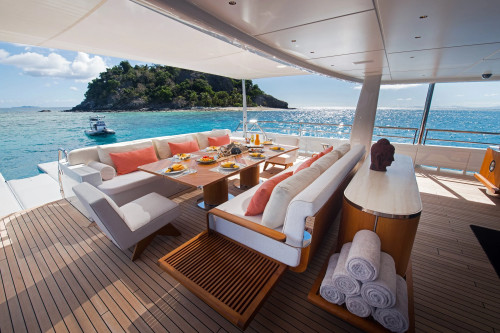
The accommodation page describes a choice of yachts that differ in size, style, and amenities. The vessel is reserved for the client and the support and treatment team, with family attendance possible by agreement. The yachts are described as unbranded for discretion. A photograph of one vessel should not be treated as a promise that the same cabins, exercise equipment, deck features, or recreational facilities will be included in a different charter.
For this service, accommodation questions have direct practical significance. Cabin access, stairs, bathrooms, motion sensitivity, and access to shore may affect whether a particular yacht works for someone with limited mobility or ongoing symptoms. The route should be considered together with those needs. A slower itinerary with more time in port may be more workable for some clients than frequent movement, but the appropriate arrangement is a matter for the client, charter team, and responsible clinicians.
The program advertises personal chef service, with menus adjusted around dietary preferences and recommendations from the treating team. It also allows recreational requests when clinically appropriate and logistically possible. Outdoor excursions and water activities depend on the destination and conditions. These features can make daily life more comfortable and engaging, but they remain distinct from the professional care that should determine suitability for admission.
Admissions, travel, and family involvement
The initial inquiry process involves discussing the presenting concerns, desired goals, possible program options, and costs. A formal telephone consultation with a senior clinician may follow. With permission, the team can speak to existing treating practitioners. This is a useful opportunity to clarify whether stabilization should happen before travel and whether the proposed voyage adds to an existing treatment plan. The provider says it will suggest alternatives when its program is not suitable.
The arrival page explains that the appropriate airport depends on the region chosen. Travel assistance can include transfers, bookings, or a companion, and additional security measures can be arranged. A family member or significant other may participate when the client agrees and the team considers it helpful. The proposal should specify whether that person joins the yacht, attends selected sessions, or participates remotely, because each arrangement has different accommodation and scheduling implications.
Fees and support after the voyage
No current numerical tariff or universal program length was established by the official pages reviewed. The provider discusses costs during assessment. A written quotation should separate the yacht and itinerary from the treatment team, medical consultations, medications, transfers, family participation, and optional services. It should explain what happens financially if the route changes, a hospital admission becomes necessary, or the program is shortened. A price quoted elsewhere for a particular voyage should not be assumed to cover a different clinical plan or charter.
The aftercare page describes local referrals, therapist conference calls, recovery coaching, and the option of a support person accompanying the client home. Coaching is usually conducted by telephone and can be arranged for different periods. The scope, frequency, and fees are matters for agreement; the website does not establish an unlimited included aftercare entitlement. The value of this phase is in specifying who will continue the work once the client returns to ordinary routines.
The Sanctuary Oceanic is best understood as a bespoke, mobile service whose exact clinical capacity depends on the proposed voyage. Its appeal lies in privacy, an individually assembled team, and an integrated daily schedule. A sound decision requires equally specific information about the accepting clinicians, the vessel, the route, emergency arrangements, and continuing care. Those details are more useful than treating the service as a fixed local hospital or assuming that an exclusive setting alone establishes the level of treatment available.
Profile reviewed on October 20, 2026 using The Sanctuary Oceanic’s official program, admission, therapy, team, accommodation, conditions, and aftercare information. The official contact page publishes +1 (778) 922-2732. The review did not independently establish a fixed Monaco campus, voyage-specific medical licensing, or a current numerical tariff.
Conditions
Amenities
Treatment approach
One-to-one psychotherapy, medical assessment as indicated, allied health, complementary practices, and individually planned aftercare
Fees & admissions
Confirm current pricing
Individual quotation required for yacht, itinerary, staffing, and treatment plan. No current numerical tariff was established on the official pages reviewed October 20, 2026; the former USD 999,000 figure is not a verified current program quote.
Confirm the current program, duration, accommodation and included services directly with the center.
Assessment required for the actual yacht, itinerary, and clinical plan. Complex medical management excludes people needing hospitalization or in an acute phase. Any detox and nursing arrangements require individual clinical confirmation.