
About TruHealing Hagerstown — Residential
TruHealing Hagerstown’s residential program
TruHealing Hagerstown provides residential addiction treatment for adults at 111 South Potomac Street in Hagerstown, Maryland. Its current website distinguishes this live-in service from the organization’s outpatient programs in nearby Funkstown. The residential program combines a structured living environment, psychological treatment, practical case management, and planning for continued recovery. The name Awakenings still appears in some directory addresses and older network wording, but the current primary website presents the Hagerstown service as TruHealing. Confirm the program and physical address when arranging an admission.
The provider’s residential treatment page explicitly describes a nonhospital setting. Although it also uses the word inpatient, the accommodation should not be understood as an acute hospital ward. The stated purpose is to give residents time away from everyday triggers while they work on the causes, consequences, and patterns associated with substance use. It may be relevant when ordinary routines make recovery difficult, but admission still depends on an assessment of the person’s current clinical and practical needs.
Who the program serves and when detox comes first
The current provider homepage identifies adults as its population. Published treatment categories include alcohol, heroin, other opioids, prescription drugs, and behavioral or process addictions. The program also describes support for mental health problems that accompany addiction, such as depression, anxiety, and trauma-related symptoms. This residential listing should not be read as confirmation of a separate primary psychiatric residential service for someone without substance-use needs. Mental health services discussed elsewhere in the network may have different admission criteria and locations.
The residential page says that this phase follows physical stabilization, while Recovery.com lists no detox service at this exact center. Broader network FAQ wording refers to managing withdrawal across the continuum of care, which does not establish an on-site Hagerstown detox unit. Anyone who may need withdrawal management should have the receiving team specify where it happens, who is clinically responsible, and what clearance is required before entering South Potomac Street. A network’s ability to arrange another service is different from providing that service in this residence.
This distinction also matters for medication. The official FAQ describes access to medical appointments, psychiatric care, and nurse practitioners as clients move through treatment. It does not provide a detailed campus prescribing protocol or a guaranteed schedule for each profession. Someone taking medication for opioid use disorder or another health condition should obtain an agreed continuation plan with their current prescriber and the receiving team. The presence of medication names in the website’s treatment menu alone does not explain that policy.
A group-centered treatment plan with individual work
TruHealing describes its plans as centered on group therapy, with additional methods selected around the individual. Living and attending sessions with other people working through addiction can provide opportunities to discuss setbacks, practice communication, and use feedback. A group-centered approach is different from an exclusive one-client program, even though each resident has a personal plan. Ask how groups are organized, who facilitates them, and how the clinical team makes room for issues that need to be discussed privately.
The published therapy menu includes cognitive behavioral therapy, acceptance and commitment therapy, motivational interviewing, trauma-focused work, and relapse-prevention counseling. These approaches are not a fixed sequence that every resident necessarily completes. Cognitive and behavioral sessions can examine patterns connecting thoughts and actions, while acceptance-based work focuses on responding differently to difficult internal experiences. Motivational interviewing provides a way to explore ambivalence about change. The provider should explain which of these approaches it proposes and how progress will be reviewed during the residential phase.
Expressive therapies give the program another way to approach emotional awareness through activities such as art, movement, or music. They sit alongside talk-based therapy and should not be counted as additional individual psychotherapy unless that is how the particular session is delivered. The program also advertises gender-specific work and dual-diagnosis treatment. Prospective residents can ask which groups are available during their dates, how gender-related preferences are discussed respectfully, and how the team adapts participation when trauma, anxiety, or another condition makes a particular activity difficult.
Twelve-step facilitation and community recovery meetings are part of the published model. Readers comparing programs should consider whether they are comfortable with this framework and how it will be integrated with clinical care. A helpful admission discussion explains expectations around meetings, sponsorship, spiritual language, and other recovery supports. It should also explain the practical alternative when someone has concerns about a particular group or approach. The value of understanding these expectations is that the daily experience can be discussed before the resident commits to a stay.
Staff roles and practical case management
The current staff page lists Sarah Atencio as clinical director, Monique Evans as assistant clinical director, and Staci Decker, RN, in an operations leadership role. It also names admissions, programming, outreach, and operations staff. These are distinct responsibilities: an RN credential attached to an administrative post is not a published bedside nursing rota. Ask which professionals will actually be involved in the proposed residential plan, including the person responsible for medication questions and any psychiatric review.
The official case management description is unusually practical. Each resident is assigned someone to help coordinate concerns that can otherwise interfere with participation in treatment. Examples include employment preparation, finding community services, arranging continued therapy, and communicating about legal or financial responsibilities. The provider explicitly distinguishes the case manager from a therapist. This role can help organize next steps, but it does not replace psychotherapy, legal representation, or a guarantee that a particular benefit or job will be secured.
For a resident who has court, work, housing, or family obligations, case management can help turn those issues into a manageable plan. The team describes liaison with legal representatives about treatment participation and support with job searches and interviews. Any information sharing should have the required consent and a clear purpose. Before admission, identify deadlines that will fall during the stay and ask what documents the program can provide. That avoids assuming that entering residential care automatically postpones outside responsibilities.
Shared accommodation and family contact
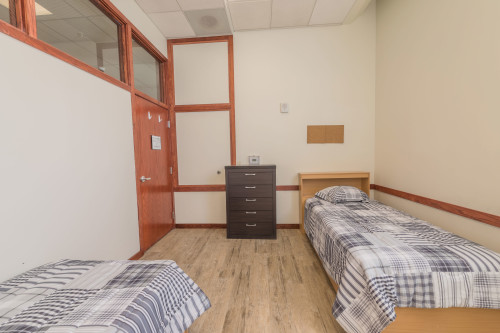
The residence is near Hagerstown’s city center. The primary site describes a renovated, comfortable environment with areas for reflection, exercise, and wellness. Recovery.com’s campus description specifies shared bedrooms with twin beds, shared bathrooms, air conditioning, and common spaces. This is a communal residential setting rather than a verified private-suite retreat. A prospective resident should confirm the current room arrangement, accessibility, storage, laundry, and any practical requirements that could affect comfort or participation.
The FAQ gives a concrete communication policy: initial restrictions after intake are followed, when approved by the primary therapist, by contact with loved ones two or three times per week. That published description should be checked for the person’s program and dates rather than treated as an unrestricted phone policy. Parents, carers, and people with important outside responsibilities should explain those needs early. Confirm the approved device arrangements, emergency family contact process, and how changes to the communication plan are reviewed.
Family work includes education about addiction, communication, boundaries, and the environment to which the person will return. The provider describes family resources and support groups, with direct participation in treatment when appropriate. This does not establish a fixed number of included family therapy appointments for every admission. Discuss who will be involved, how consent is recorded, whether sessions can be remote, and how the team will handle family relationships that are strained or unsafe. Ordinary calls and clinical family sessions serve different purposes.
Length of stay, costs, and admission planning
The official FAQ makes treatment duration dependent on the assessed level of care and the individual plan. Recovery.com gives thirty days as a typical residential stay, which is useful as a secondary planning reference rather than a provider-guaranteed completion date. A discharge decision should consider readiness for the next setting and available support, not simply the arrival of a calendar deadline. Ask when the team reviews progress and how any extension or transition will affect accommodation, insurance authorization, and the overall cost.
Recovery.com lists an estimated USD 20,000 for thirty days, checked October 20, 2026. That is a third-party program estimate, not a confirmed official daily rate or universal monthly tariff. The provider offers insurance verification and says it accepts major carriers, while the directory says Maryland Medicaid covers some programs. Those statements do not establish that a particular residential admission is covered by a particular policy. Obtain the exact service authorization and written personal cost estimate before treating a network-wide insurance statement as confirmation.
The packing information includes identification, an insurance card, prescriptions, money for medications, suitable clothing, toiletries, and exercise clothes. Mentioning medication money is a reason to clarify pharmacy and prescription costs separately from the quoted residential fee. Ask about outside medical appointments, transport, testing, and any charges associated with extending care. The current primary contact number is 833-297-4343. The admission discussion should connect clinical assessment with these practical details rather than leaving the resident to resolve them after arriving.
Continuing treatment at the separate Funkstown site
TruHealing’s outpatient page places PHP and IOP exclusively at 108 East Baltimore Street, Funkstown, Maryland 21734. These programs allow clients to live outside the treatment center while continuing structured sessions, and may provide a step-down after Hagerstown residential care. They require their own schedule, transport, housing arrangements, and funding confirmation. A familiar organization can support continuity, but moving to a lower level of care is still a meaningful change in daily supervision and responsibility.
Discharge planning also includes relapse-prevention strategies, continued therapy, and connection with support resources. Residents returning farther away should ask for local appointments and an explicit handover rather than assume regular travel to Funkstown is practical. Identify the next clinician, medication responsibility, and first appointment before leaving the residence. When comparing other addiction and mental health programs in the United States, use this complete pathway—residential treatment, the separate outpatient option, and care at home—to judge whether the proposed plan fits the person’s circumstances.
Destinations
Conditions
Levels of care
Program approach
Group-centered individualized care with CBT, ACT, motivational interviewing, trauma-focused and expressive approaches, individual and family work, twelve-step facilitation, relapse prevention, case management, medical/psychiatric access and discharge coordination
Fees & admissions
Estimated USD 20,000 / program
Recovery.com estimated USD 20,000 for thirty days, checked October 20, 2026. This is a third-party program estimate, not an official tariff or a daily/monthly rate. Confirm the individualized duration, medication and testing charges, external medical care, transport, any preliminary detox, and exact insurance or Maryland Medicaid coverage for this residential admission rather than another network program.
Confirm the current program, duration, accommodation and included services directly with the center.
Confirm residential suitability and any required prior detox, medication continuation and current medical/psychiatric availability, shared-room needs, communication and packing rules, individualized duration, written program and medication costs, exact insurance benefits, and transport/housing for the separate Funkstown outpatient step-down.