
Care at Mas Ferriol — Girona
Mas Ferriol: a small residential clinic in Girona province
Mas Ferriol is a private medical and psychological treatment provider in Girona province, Spain, specializing in addiction, co-occurring mental health conditions, and personal crises. Its residential service occupies a restored rural farmhouse between Olot and Banyoles and has seven places. The official website emphasizes individual work, close observation, and contact between residents and a small professional team. This makes it a different proposition from a large rehabilitation campus: the program combines private bedrooms with a shared therapeutic living environment, while treatment goals and length of stay are assessed individually.
The clinic was founded in 2006 by Dr. Xavier Fàbregas and Liselott, also known as Lotta, Nilsson. The provider describes medical care, psychology, neuropsychology, and support with daily routines as complementary parts of its model. It offers residential, outpatient, and online formats, so an initial assessment is intended to determine which level of support fits the person. Someone interested specifically in the Girona residence should have that location and format confirmed. An outpatient appointment in Barcelona or an online session is a different service from living at the farmhouse.
Voluntary admission and the treatment plan
The clinic’s FAQ states that residential admission is voluntary. It describes a typical patient group often between ages 30 and 60, while noting that younger and older people have also attended. That is a description of previous residents, not a strict published age limit. The first clinical interview considers the person’s circumstances and provides guidance to the patient and family. Someone whose medical, cognitive, or psychiatric needs may affect participation should explain them before booking rather than assume that a small resident group can support every level of dependency.
Mas Ferriol’s residential description begins with assessment of substance use, physical and mental health, and other relevant factors. The team develops a plan that can include medical withdrawal management when needed, psychological work, and changes to daily habits. The provider also describes a review of engagement after the first two weeks. This reflects its expectation that residents participate actively in a shared therapeutic environment. Families seeking help for someone who is reluctant to attend should discuss that situation with the team; the website does not describe involuntary detention as part of the service.
Individual sessions and diagnostic work
The residential page specifies five individual sessions each week across three professionals, described as a psychologist, a neuropsychologist, and a doctor. This is a useful measure of the published treatment intensity, but it should not be read as five psychotherapy sessions plus five separate medical visits. The purpose of involving several disciplines is to understand different aspects of the person’s difficulties and response to treatment. A prospective resident should receive a schedule explaining the role of each appointment, how the professionals coordinate, and how changes in the plan are communicated.
Individual work is described as addressing the situations surrounding substance use, emotional experiences, thoughts, coping strategies, and new habits. The clinic also emphasizes understanding how a person uses free time and what previously occupied that time. These are practical treatment areas rather than a promise that one named technique is used universally. The reviewed core pages do not establish a single mandatory CBT, EMDR, or 12-step protocol for every resident. The clinical team should explain which methods it proposes for the individual’s formulation, who delivers them, and why they are appropriate.
The dual-diagnosis page describes coordinated treatment when substance use and another mental health condition occur together. It explains that symptoms are reassessed as the person stabilizes, with attention to whether they persist and what further treatment is needed. That approach makes ongoing observation part of the diagnostic process. It should not be simplified into a rule that every psychiatric symptom disappears after detox or that a diagnosis can always be settled within a fixed number of days. Relevant treatment records and the history before substance use can be important to that assessment.
Mas Ferriol publishes medical supervision and medication review under Dr. Fàbregas. The FAQ emphasizes using medication when needed and adjusting it according to the individual’s response. That is a provider approach, not advice for prospective patients to reduce their own prescriptions. Anyone taking psychiatric medication, prescribed pain treatment, or medication for substance use disorder should ask the doctor to clarify the plan before admission. The clinic’s general descriptions of detox duration are estimates rather than a guarantee that withdrawal or stabilization will be complete within one week.
The people delivering care
The current team page identifies Dr. Xavier Fàbregas as medical director and cofounder, and Lotta Nilsson as director and cofounder. It lists Joana de Lorenzo, Clàudia Mohr, Isabel Nogué, Avril Fortià, and Marina Font among its health psychologists, with Nogué also identified as a neuropsychologist. The page describes different professional backgrounds and roles within the team. These are provider-published qualifications, not an independent verification of every registration. They give prospective residents a basis for asking which clinicians will be assigned to their treatment.
The team also includes sociotherapists, practical support staff, a personal trainer, and a chef. These roles are relevant because the residential approach extends beyond formal office appointments into daily routines and shared living. Staff may observe how a person handles time, relationships, frustration, and self-care, then bring those observations into the therapeutic discussion. Medical and psychological responsibilities still need to be distinguished from general support. The provider’s description of continuous attention should not be interpreted as proof that a physician or registered nurse is physically present on site every hour.
Groups, family work, and communication
Group sessions are part of Mas Ferriol’s model, with discussion of addiction, stress, practical skills, and relapse prevention. The public pages are not fully consistent about frequency: the FAQ describes two group sessions each week, while other program passages refer to daily groups or weekly workshops. The most accurate expectation is that group work is offered and the current schedule needs confirmation. This matters when comparing programs by treatment intensity. The five weekly individual contacts are stated more specifically, while the mix of group sessions and activities may vary with the current program.
Family and partner involvement includes education, therapeutic sessions, and guidance on supporting the person during treatment and afterward. The residential page says in-person family therapy is included in the treatment fee and describes help with the logistics of visits. Contact should be organized with consent and clinical goals in mind, rather than treated as unrestricted access to every discussion. Families can use sessions to clarify expectations, communication, and responses to difficulties at home. Their participation is intended to provide support and understanding, without assigning them responsibility for controlling another person’s recovery.
The FAQ recommends that relatives wait approximately two weeks before an initial visit, giving the resident time to settle into the program, and says visits should be arranged with the therapeutic team. At the same time, patients are allowed to retain their phones and internet access from admission. The provider frames this as an opportunity to practice managing time and contact rather than removing all ordinary responsibilities. Someone who plans to work during treatment should still establish what is realistic alongside daily appointments and activities. Device access does not imply that a full workday can take priority over treatment.
Private rooms and the rural setting
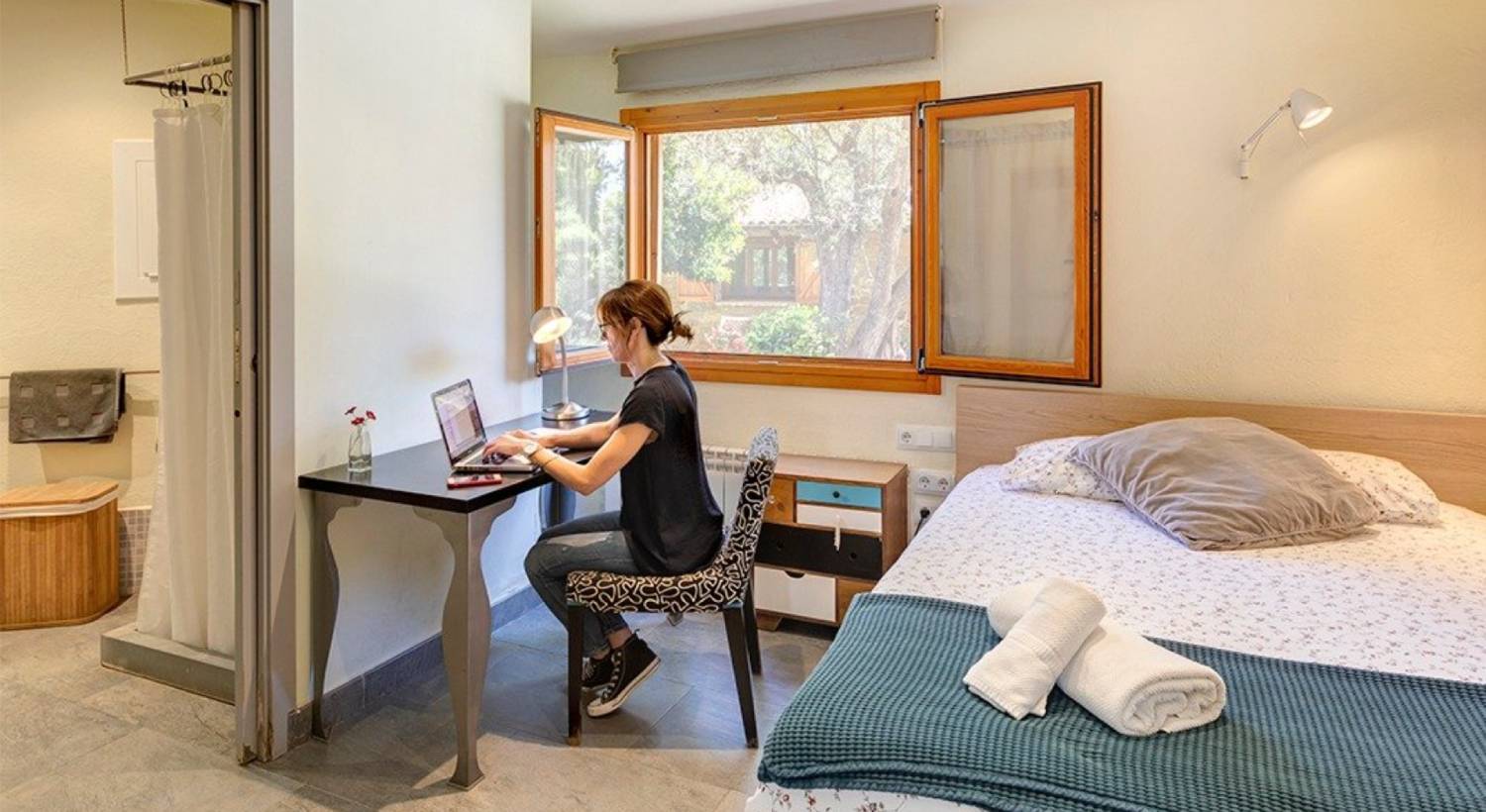
The farmhouse offers seven individual bedrooms with double beds and study space with Wi-Fi. The homepage and residential page say most rooms have a private bathroom, although the FAQ uses broader wording suggesting a private bathroom for each patient. Because those descriptions differ, a booking should identify the exact bathroom arrangement for the allocated room. The private bedroom itself is a consistent part of the published offer. This distinction is useful for people for whom bathroom privacy, accessibility, or room location materially affects the feasibility of a six- to eight-week stay.
Published facilities include gardens, communal dining and living areas, a library, a kitchen, and spaces for individual and group sessions. The provider also lists a gym, exercise equipment, and opportunities for activities such as table tennis, badminton, basketball, walking, and running. An organic vegetable garden supplies some seasonal produce for meals. These features support daily life and opportunities to build routines; they should not be presented as separate medical treatments. Activities and menus are described as adaptable to patients’ needs, which should be discussed in advance if health or mobility affects participation.
Practicing the return to everyday life
A distinctive element described in the FAQ is a therapeutic visit to the person’s usual environment, lasting two days when approved by the team. The aim is to experience everyday circumstances while there is still an opportunity to return and work through difficulties. The provider says these visits are assessed beforehand and coordinated with family or partners. They are not automatic leave for every resident. For someone traveling from another country, the practical value and feasibility need careful discussion: the equivalent exercise may require a different plan from a short trip to a nearby home.
Mas Ferriol describes urine testing after return from these visits and during follow-up, alongside therapeutic discussion. Testing is one source of information; it should not be understood as guaranteeing future abstinence or fully describing a person’s wellbeing. The clinic says a setback during a planned visit can be examined within the treatment process to understand what happened and strengthen the plan. Before a visit, it is useful to agree the intended activities, support available, communication with the team, and what the person should do if the situation becomes difficult.
Duration, price, and follow-up options
The FAQ describes an initial residential stay generally designed around six to eight weeks, adjusted according to the assessment. The reviewed official pages do not provide a current numeric tariff. They describe the clinic as fully private, with no public subsidy or financial aid offered through the service. The residential page says services are included in the treatment rate, but a written quotation should still define the room, medical care, therapy, investigations, visits, and any extension. Post-residential treatment should be identified separately so that ongoing appointments are not assumed to be included indefinitely.
After residential treatment, Mas Ferriol describes weekly individual follow-up, attention to difficulties arising at home, and testing when relevant. Its online service offers video appointments with psychology or medical professionals and the possibility of combining remote work with visits in Barcelona or Girona province. The provider explicitly says online treatment is not appropriate for every case. International patients should confirm the language of therapy, their location during remote sessions, prescribing arrangements, time zones, and which professional will provide local help if a higher level of support becomes necessary.
Mas Ferriol is most clearly evaluated through its small resident group, five weekly individual contacts across disciplines, medical oversight, voluntary participation, and deliberate practice of everyday routines. People comparing residential treatment options can ask for a proposal that resolves the few inconsistencies in the public description, especially group frequency and bathroom allocation. The clinic’s contact team can clarify those practical details alongside clinical suitability, language, fees, and follow-up. A specific plan will make it easier to decide whether the intimate residential format matches the person’s needs.
Information checked October 20, 2026 using official Mas Ferriol pages. The published residential model has seven places and generally lasts six to eight weeks. Group-session frequency and bathroom descriptions vary between pages, so this profile makes those uncertainties explicit. Individual admission, medication, current fees, and follow-up arrangements require confirmation.
Conditions
Levels of care
Settings
Amenities
Treatment approach
Five weekly individual sessions across medical, psychology, and neuropsychology; medical review, group and family work, psychoeducation, daily routines, and therapeutic return-home visits when approved
Fees & admissions
Confirm current pricing
No current numeric tariff verified. Fully private clinic; FAQ says no subsidies or financial aid. Request written inclusions, room, length, medical services, extensions, and separate follow-up costs. In-person family therapy is described as included during treatment.
Confirm the current program, duration, accommodation and included services directly with the center.
Voluntary admission after clinical assessment. Confirm medical and psychiatric suitability, current medications, therapy language, engagement expectations, group timetable, and room/bathroom allocation.