
Care at The Refuge — Ocklawaha
The Refuge in Ocklawaha: trauma treatment within a residential community
The Refuge, A Healing Place is an adult behavioral health provider on a wooded campus in Ocklawaha, Florida. Its central focus is the relationship between trauma, mental health symptoms, eating difficulties, and substance use. Addiction is not a requirement for every admission: the provider also describes treatment for people whose main concerns are trauma, depression, or other mental health difficulties. A person considering The Refuge should therefore begin by identifying the relevant program, because its general residential service, Oak House eating disorder program, detoxification service, and partial hospitalization program have different purposes and schedules. The official website describes these pathways as parts of a broader treatment continuum, rather than interchangeable versions of the same stay.
The setting is a substantial part of the experience. The provider describes 94 acres in the Ocala National Forest, with cabins, outdoor recreation, and space between treatment activities. That environment may appeal to someone who wants distance from their usual routines while doing intensive therapeutic work. It also means considering practical needs such as walking between buildings, access to a particular bedroom, and transport to outside appointments. A forest location does not establish the medical intensity of a program; the admissions team still needs to assess whether the person’s psychiatric, physical, and withdrawal needs can be managed there.
How the residential program approaches trauma and recovery
The residential program begins with a clinical, medical, and social assessment. The published schedule includes two therapy groups a day, individual therapy, and daily therapeutic recreation. Group work uses personal assignments and discussion to explore the connections among trauma, coping, relationships, and current difficulties. The provider lists concerns including posttraumatic stress, substance use, process addictions, codependency, and co-occurring disorders. This is a broad description of the people it considers for care, not confirmation that every diagnosis can be treated at every level of acuity.
Cognitive behavioral therapy, trauma-focused interventions, and recovery groups appear across the provider’s program descriptions. Its detox page also identifies eye movement desensitization and reprocessing, while its partial hospitalization page names dialectical behavior therapy and narrative exposure therapy. These approaches have different functions within a plan. Cognitive and behavioral work can examine patterns that maintain distress; skills groups may concentrate on emotion regulation and coping; trauma processing requires its own preparation and clinical decisions. Applicants should discuss which methods their assigned clinician actually uses, how the team decides when to begin trauma work, and how progress is reviewed alongside medication and daily functioning.
The provider includes 12-step meetings within its addiction treatment model, both on and off campus. That is relevant to someone who already uses this form of peer support or wants to explore it, but it should not obscure the professional treatment components. Someone attending primarily for trauma or depression should clarify how much of their own schedule involves addiction-oriented groups and which sessions address their main condition. The published material supports individualized planning; it does not give a guaranteed number of individual psychotherapy appointments for every resident.
Medical detoxification and the transition into therapy
The Refuge describes a medically assisted detoxification program supported by nursing staff and medical supervision. Its published average is seven to ten days, adjusted according to the individual. Detox commonly leads into residential treatment, and the provider describes continued medical monitoring as the person moves through subsequent stages. This matters because the withdrawal phase and the broader therapeutic stay should be planned together. Completing detoxification is not presented here as completing all of the work needed for a substance use disorder.
The website discusses medication options as examples of individualized care. Their appearance on a program page does not mean that any particular medication will be appropriate or available to every applicant. Before admission, the medical team needs a complete list of prescriptions, recent substance use, previous withdrawal complications, and relevant medical conditions. A current prescriber should be involved in decisions about continuing or changing medication. The useful comparison is the actual proposed assessment, monitoring, and follow-up arrangement, rather than whether a provider lists a long medication menu online.
Oak House: a separate eating disorder program
Oak House at The Refuge is a standalone, sixteen-bed residential eating disorder program on the campus. It serves adults of all genders aged eighteen and older. Sixteen beds refers to this particular program, not the capacity of the entire Refuge property. Oak House describes a community model that encourages feedback, participation, and support, together with a Health at Every Size perspective and an approach in which foods are not divided into rigid moral categories. These are descriptions of its care philosophy, rather than a substitute for an individualized nutritional or medical assessment.
The published treatment methods include dialectical behavior therapy, acceptance and commitment therapy, mindfulness-based therapy, and Forward-Facing Trauma Therapy. Its curriculum covers nutrition, distress tolerance, emotion regulation, interpersonal effectiveness, body image, social media, cooking, and the relationship between body and mind. Meal support, nutrition support, medication management, and relapse prevention may also form part of a plan. This makes Oak House a more specific service than a general residential program that simply lists eating disorders among its interests. A prospective resident should confirm the medical admission criteria and the experience of the team with their particular presentation.
Oak House lists anorexia, bulimia, binge-eating difficulties, avoidant or restrictive eating, and other eating disorder presentations among the concerns it addresses. Care planning starts with an assessment of needs, strengths, and preferences. Discharge planning also begins early, with the therapeutic team and clinical liaison considering the next level of support. The provider describes possible transitions to its partial hospitalization service or referrals to other services. Those options need to be matched to the person’s needs; a referral list does not establish that a specific outside bed or appointment has been secured.
Partial hospitalization with on-campus accommodation
The partial hospitalization program, or PHP, is an important distinction when comparing The Refuge with a conventional day program. Its published model involves six hours of treatment each day while participants continue living in campus cabins. Most enter after residential treatment, although direct admission may be possible when assessment supports it. PHP therefore offers increased independence within a continuing residential environment, rather than automatically meaning that the person returns to their own home every evening.
The PHP menu includes CBT, DBT, narrative exposure therapy, trauma processing, self-empowerment, recovery, relapse prevention, and meditation groups. The provider also describes accompanied excursions, outside 12-step meetings, and phone use at specified times in designated media rooms. These opportunities require therapist approval and take place outside treatment hours. Someone arranging remote work or regular family calls should confirm the actual device policy for the program they will attend. Massage may be available for an additional charge, so it should not be assumed to be part of an inclusive daily fee.
Military personnel, veterans, and first responders
The Refuge’s Service Resiliency Unit is aimed at military personnel and first responders, including veterans, law enforcement officers, firefighters, emergency medical personnel, and dispatchers. It emphasizes occupational trauma and related mental health or substance use concerns. The program page also mentions veterans’ families. Applicants should confirm the precise eligibility and treatment format for a family member, as a reference to families does not by itself establish a joint residential placement or a particular family therapy schedule.
There is an inconsistency in the provider’s public funding information: the military page retains wording about accepting only commercial insurance, while the current insurance page lists TRICARE East as a participating arrangement and VA Community Care Network coverage through Optum. The site also carries a VA Community Care banner. Veterans and service members should use the current benefits-verification process and confirm any required authorization with their payer. It would be inaccurate to treat either a banner or the older commercial-only sentence as a complete eligibility decision.
Cabins, staff roles, and arrival planning
The location page identifies the campus at 14835 Southeast 85th Street Road in Ocklawaha. Accommodation is described as cabins, with many rooms arranged for two occupants. The page’s overall capacity and gender-specific bed figures do not reconcile precisely, so this profile does not present a single total bed count as verified. Ask for the actual room type, bathroom arrangement, accessibility features, and unit placement in the admission agreement. A private room should not be inferred from photographs of the grounds or from a reference to an individual cabin.
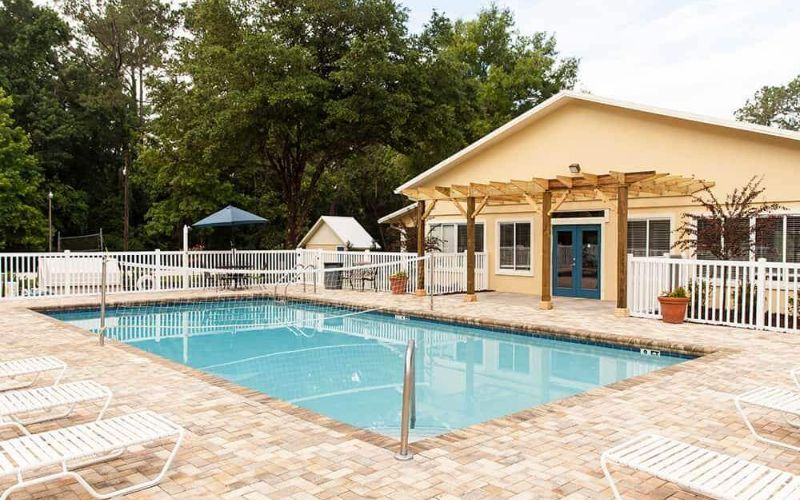
Published recreation facilities include a swimming pool, volleyball and basketball areas, trails, a labyrinth, and a fishing dock. Activities remain subject to clinical suitability, supervision, weather, and the current schedule. The staff directory identifies Stephanie Evan, MSN, RN, CARN, as chief executive officer, Emily Negherbon as director of nursing, and Dr. Timothy Gooden as medical director. Those are provider-published leadership roles; they do not specify each resident’s assigned clinician or establish the exact overnight staffing arrangement. Those details are best confirmed for the relevant unit.
The admissions process is for adults eighteen and older and includes review of clinical history, medications, prior treatment, and medical records when authorized. The clinical and medical directors review suitability, and the provider describes making referrals when it cannot meet an applicant’s needs. Its travel guidance places Orlando International Airport roughly an hour and a half away. Before booking travel, obtain confirmation of acceptance, the planned arrival time, transport arrangements, and any medical clearance that must be completed first.
Length of stay, insurance, and continuing support
The insurance and payment page describes a longer-term residential model, with stays estimated at approximately ninety days or more. That is distinct from the seven-to-ten-day average given for detoxification. No current numeric self-pay tariff was verified in the official pages reviewed for this profile. Fees depend on the program and individual needs, and later recommendations may create additional costs. A written estimate should therefore identify the proposed level of care, expected duration, professional charges, accommodation, and what happens financially if the stay changes.
The provider lists several commercial insurance arrangements, along with the military and veterans’ options described above, and states that it does not accept Medicare or Medicaid. Verification does not guarantee full payment: its own financial guidance explains that insurers may authorize care in increments or change coverage after reviewing progress. The relapse prevention guidance emphasizes a continuing plan that identifies personal supports, stressors, and community services. Before leaving, the practical goal is a plan with named follow-up contacts and realistic access to the next level of care, rather than assuming that time on campus alone completes recovery.
Conditions
Levels of care
Settings
Treatment approach
Trauma-focused assessment and therapy, CBT, individually indicated EMDR, DBT and narrative exposure therapy, recovery and 12-step groups, medical care, recreation, and continuing-care planning; Oak House has a distinct eating disorder curriculum
Fees & admissions
Confirm current pricing
No current numeric tariff verified. Fees and duration depend on assessed care. Current payment page lists commercial insurers, TRICARE East participation and VA CCN–Optum; Medicare and Medicaid are not accepted. Obtain plan-specific authorization and an itemized estimate.
Confirm the current program, duration, accommodation and included services directly with the center.
Adults 18+ require clinical and medical review. Addiction is not required for every mental health admission. Confirm the specific unit, medical suitability, medication plan, room, and insurance authorization before travel.