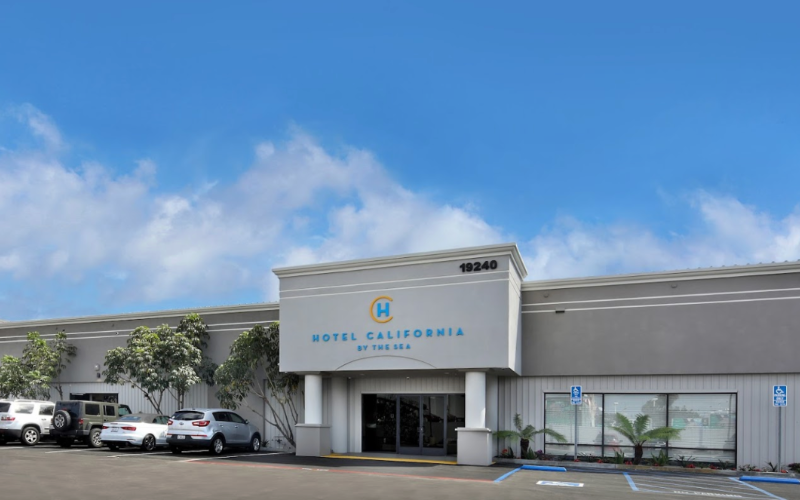

About Hotel California by the Sea — Newport Beach
Hotel California by the Sea provides addiction treatment through several Orange County locations, including residential care in Newport Beach and services in Huntington Beach. Its program descriptions cover detox, residential treatment, and outpatient support for substance use and co-occurring mental health needs. The distinction between those locations matters: a general brand description does not establish that every service takes place in the same house. This profile retains the Newport Beach listing while explaining the wider treatment pathway, the questions to ask about the assigned residence, and the separate third-party estimates for residential care and detox.
Newport Beach and the other Orange County locations
The official website publishes 2811 Villa Way, Newport Beach, CA 92663, as a contact address. California’s public facility data separately identifies a licensed residential location at 4504 Seashore Drive in Newport Beach. Do not assume that the contact address is the bedroom location or the place where withdrawal will be managed. Ask the admissions team to identify the precise receiving house, clinical service, and arrival instructions in writing, especially if a person is transferring directly from another provider.
The Department of Health Care Services record for the Seashore Drive location, application 300270AP, describes six residential places and marks incidental medical services as not provided under that record. The same provider has separately listed residential detox locations in Huntington Beach with incidental medical services. The dataset was last edited August 17, 2026, so it is dated facility evidence, not a live bed-availability report. Its main implication for an inquiry is that each stage of care needs an exact address and an explanation of the resources available there.
The provider’s contact page gives (866) 502-8200 as its admissions line. Several other numbers appear across its public pages, so ask the representative to confirm that the conversation concerns the Orange County program and the requested residential location. The brand also describes programs outside California. Their staff, facilities, and services should not be treated as if they were automatically part of the Newport Beach stay. A written placement summary can prevent a general inquiry from becoming an unclear multi-location booking.
Detox and the residential phase
The detox information describes assessment, medication when indicated, monitoring, and planning for the next treatment stage. Ask where the proposed detox will take place, who is responsible for medical decisions, and whether moving into residential care requires a transfer between houses. Clarify transport, record sharing, and any separate financial authorization. The provider’s broad wording about Newport Beach detox should not replace confirmation of the actual licensed receiving location and the level of support available for a particular withdrawal risk.
The residential page uses inpatient terminology and describes live-in treatment with regular assessment and therapy. That terminology does not establish that each house is a general hospital or that a physician is continuously onsite. Ask who is physically present overnight, which clinical professionals attend the residence, how a prescriber is reached, and when outside medical care is required. These questions are especially important when the person needs support beyond the services authorized at the assigned property.
For an initial assessment, prepare current prescriptions, relevant medical records, recent substance-use history, and information about previous treatment or difficult withdrawal. Ask how medication continuity is managed when moving between detox and residential settings and who handles refills afterward. The length of a priced detox package cannot predict how long an individual will need medical support. Likewise, an advertised residential duration should not determine a discharge date without a clinical review of the person’s progress and the care available next.
What treatment may involve
Hotel California describes individualized treatment for addiction and related mental health concerns, including individual and group work. Its residential information names cognitive behavioral approaches, dialectical behavior methods, and EMDR among available therapies. Ask which interventions are proposed, who delivers them, and how many individual appointments appear in the resident’s actual week. A list of modalities is less useful than knowing the planned clinical work, the size of the treatment group, and how staff review a plan that is not meeting the resident’s needs.
The provider’s program descriptions distinguish men, women, and young adults. Ask which group or residence would be assigned and whether age, gender, clinical needs, and available space affect that decision. Do not assume that a program name guarantees a particular peer group or a private room. If trauma is a major concern, ask how assessment, stabilization, and any trauma-focused work are sequenced. The availability of a named intervention does not establish that it is suitable for everyone at the same point in treatment.
The residential tour page says Twelve Step meetings are encouraged but not required. Someone who prefers a different recovery community should ask which alternatives are supported and how meeting participation fits with the clinical timetable. This is also a useful opportunity to discuss beliefs and previous treatment experiences openly. The goal is to understand what daily participation actually entails rather than infer the program’s expectations from a broad label such as holistic care or a list of mutual-help organizations.
Accommodation and daily life
The official residential information describes full-size beds, storage, meals, and comfortable shared living areas. The independent Recovery.com profile lists private or shared room options. Confirm the house, room type, number of occupants, bathroom arrangements, and any private-room supplement for the proposed dates. A private-room option across the provider’s facilities is not a guarantee of a private bedroom in the assigned Newport Beach residence, and photographs of different houses should not be combined into an assumed single property.
Ask about accessibility, dietary needs, telephone and laptop rules, laundry, storage of valuables, and the arrangements for leaving the residence. The provider describes nearby beach activities and other wellness opportunities, but availability can depend on the clinical plan, staffing, and conditions that day. Confirm which activities are included, where they take place, and whether transport or entry fees are additional. These details help explain residential life without treating proximity to the coast as evidence of a treatment outcome.
Family participation and continuing care
The family program page publishes a group program on the first Friday of each month, with licensed therapists and counselors involved. It describes participation for relatives and friends of residents in both inpatient and outpatient services. Confirm the upcoming date, venue, consent arrangements, age requirements, and whether a remote option exists before booking travel. Ask whether the meeting focuses on education, shared therapeutic work, or practical planning, because those activities may call for different preparation from the resident and support person.
The provider places its Orange County outpatient facility in Huntington Beach. Its outpatient information describes partial hospitalization and intensive outpatient care, as well as assistance with educational, vocational, and transitional-housing needs. Those are separate services from living in the Newport Beach residence. Ask for the receiving address, timetable, eligibility, and financial arrangement before discharge. A referral or a discussion of available housing should not be interpreted as a reserved place or an included residential extension.
For an extended local stay, request separate contact details for the housing operator and treatment team. Establish who responds to a concern at the residence outside clinic hours and whether changing accommodation would affect access to scheduled treatment. These arrangements can differ even when services share a brand.
If a person plans to return home outside Orange County, ask how the team will coordinate care there. A useful plan identifies the receiving clinician, first appointment, medication arrangements, and a realistic routine for the first weeks. Someone staying locally should establish where they will sleep, how they will reach treatment, and whether outside commitments fit the proposed schedule. The transition should be planned around actual services and appointments, rather than assuming that all parts of a brand’s continuum are automatically available or covered.
Residential and detox prices are separate
On October 20, 2026, Recovery.com displayed an estimated $42,500 for 30 days of residential care. It separately listed $7,500 for five days of detox and $1,000 for each additional detox day after that. These are third-party estimates, not a current provider tariff. The residential figure is a 30-day program estimate, not an indefinite monthly rate. The detox figures are preserved as a separate service and are not automatically added to the residential amount or used to predict the total cost of someone’s admission.
Request a quotation that names each treatment location and shows how charges change between stages. Ask whether the residential price includes the proposed room, individual therapy, medical consultations, prescriptions, laboratory work, transport, and family participation. If detox is required, clarify whether any days overlap for billing purposes and what happens when clinical needs extend the stay. Also obtain the deposit, payment schedule, extension rules, and early-departure or refund terms. A clear financial agreement should match the actual sequence of services being recommended.
The official insurance page offers benefits verification and says the provider works with major insurers. Confirm the specific policy, receiving entity, location, and level of care rather than relying on an insurer’s logo or a general statement about low personal cost. Ask about network status, authorization, deductible, coinsurance, and separate professional bills. Coverage for a detox admission does not automatically establish coverage for a private room, an extended residential stay, or later outpatient care at a different address.
Making a location-specific decision
Hotel California by the Sea may be relevant when its assessed residential program and wider Orange County services fit the person’s needs. Compare it with other United States treatment options using the same questions about actual location, medical resources, room assignment, price, and continuing care. The residential care guide and outpatient care guide can help organize that comparison. Before committing, seek a written plan that identifies where each stage happens and how the clinical and financial handoffs will work.
Sources and verification
Reviewed October 20, 2026. Sources include linked official provider pages, dated Recovery.com estimates, and the California DHCS public facility dataset, layer last edited August 17, 2026. Record dates and campus distinctions do not establish current bed availability. Individual clinical eligibility, exact placement, and fees require confirmation.
Destinations
Conditions
Levels of care
Settings
Amenities
Program approach
Individual and group work, co-occurring mental health support, cognitive behavioral and dialectical behavior methods, EMDR when appropriate, family participation and continuing-care planning
Fees & admissions
Estimated USD 42,500 / program
Recovery.com checked 2026-10-20 estimates USD 42,500/30 days residential; separately USD 7,500/5 days detox and USD 1,000 for each additional detox day. Not an official tariff. Keep program period, exclude automatic detox addition, and obtain a current quote identifying the actual treatment locations and room.
Confirm the current program, duration, accommodation and included services directly with the center.
Confirm the Orange County program, exact receiving house and level of care, medication and medical needs, current room, insurance, transport between sites and written quote. Current dedicated contact page publishes 866-502-8200.