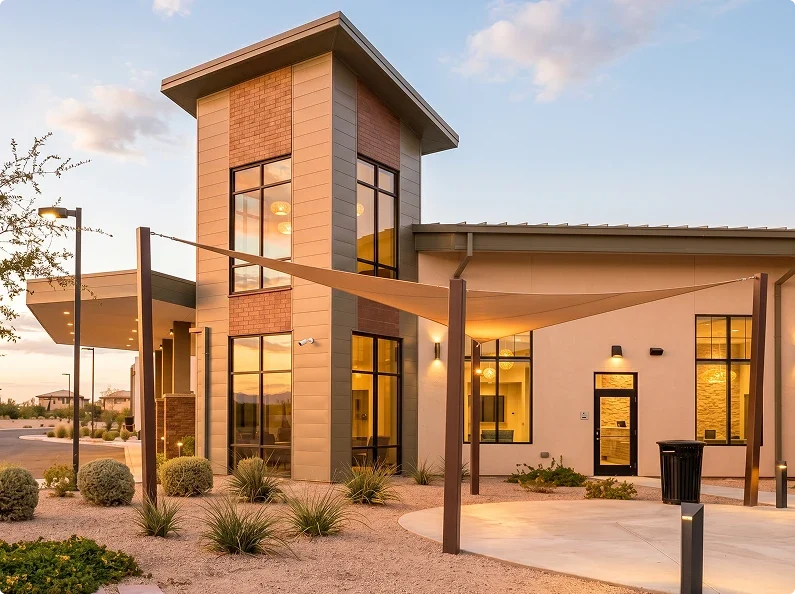

About Buena Vista Recovery — Chandler
Buena Vista’s Chandler treatment facility
Buena Vista Health & Recovery Centers provides detoxification, residential treatment, and outpatient services at 3033 South Arizona Avenue, Chandler, Arizona 85286. Its current Chandler location page directs new admissions to this campus and describes the treatment levels as operating in one building. The admissions number is 888-362-5576, while 480-680-0606 is published as the facility line. Call before arriving so that assessment, clinical review, availability, and the receiving arrangements can be confirmed.
This profile concerns the Chandler service. The provider’s current information describes medical detoxification and residential care followed by less intensive treatment without a change of facility. That can be a useful practical feature, but an individual plan still needs to identify the starting level, goals, clinical responsibilities, and later living arrangements. Moving between levels does not mean remaining in a residential room throughout the whole course or receiving identical services at every stage.
What the treatment phases involve
The medical detoxification page describes nursing support, physician oversight, medication when appropriate, and planning for the next phase. Discuss current substance use, previous withdrawal complications, medical history, psychiatric concerns, and prescriptions with the assessing team. Ask what monitoring is needed in the individual case and how the facility handles a need for care elsewhere. A public program description is not an individual withdrawal plan or a reason to change medication without clinical advice.
The residential program page describes a stay after stabilization, with group therapy, individual appointments, and case management. Ask which therapist will coordinate the plan, how often individual sessions occur, and how medical or psychiatric reviews are arranged. The provider describes continuous onsite nursing and support, but that does not by itself establish hospital-level inpatient admission. The appropriate question is whether the actual Chandler resources can support the person’s current needs.
Buena Vista describes care for substance use alongside anxiety, depression, trauma-related concerns, and other mental-health needs. Ask how these concerns are assessed together and which symptoms or medical conditions would require a different setting. The co-occurring conditions guide offers a framework for comparison. A broad commitment to integrated care should result in a specific explanation of clinical suitability, psychiatric follow-up, and the response if the person’s needs change.
Medication scope needs an individual answer
The Chandler page describes medication during withdrawal while separately listing medication-assisted treatment among needs that admissions may help people reach through referral. Those statements should not be combined into a promise that every ongoing medication service is provided onsite. Tell the team about current prescriptions, including existing treatment for opioid or alcohol use disorder, and ask which medicines can be continued, prescribed, or monitored at each level and which require another provider.
If an outside prescriber is involved, establish who communicates with them, how records are transferred, and who arranges follow-up appointments. A move from detoxification into residential or outpatient care should include a clear medication handoff rather than an assumption that the same prescribing arrangement continues indefinitely. The public website’s broad terminology is a starting point for those questions; the actual plan should identify the responsible clinician and the service available to the individual.
The expected course and the later living arrangement
Buena Vista’s duration guide gives general reference ranges of four to seven days for detoxification, around thirty days for residential treatment, and approximately ninety to 120 days for a course continuing through outpatient care. These are provider descriptions, not a fixed timetable for everyone. The full-course figure should not be presented as three or four months of residential accommodation. Ask for the recommended phases, review dates, and the criteria for adjusting them.
The Chandler page describes PHP as a full clinical day without living onsite and IOP as fewer hours on several days of the week. Obtain the actual current timetable and attendance requirements before planning work, education, or caregiving around it. Although the provider describes continuity within the same building, confirm how the clinical team and appointments change at each level. The recommended schedule should be based on assessment and practical support, rather than convenience alone.
Later treatment assumes a suitable place to live outside the residential unit. Buena Vista describes help finding sober living or supportive housing, which should be distinguished from providing that housing itself. Ask who owns and operates a proposed home, what supervision it offers, and what rent, meals, and transport cost. A treatment fee or a referral does not establish that a bed elsewhere is included, reserved, or appropriate for every person.
Private rooms and everyday practicalities
The current Chandler page explicitly describes private rooms with ensuite bathrooms, meals, and shared recreational spaces. The exact Recovery.com profile also describes private accommodation for detoxification and residential clients. Confirm the actual room available for the proposed dates and any accessibility requirements. This room arrangement belongs to the residential and detox phases; it should not be assumed to provide overnight accommodation during later PHP or outpatient attendance.
The provider says services are currently delivered in English and asks prospective clients to discuss dietary and accessibility needs. Someone requiring language assistance should establish what support is available before arrival rather than assume the whole clinical program can be delivered in another language. Ask about stairs, bathroom access, mobility, meals, and any necessary adjustments. The provider also welcomes service animals; clarify the current arrangements and any required preparation before traveling with an animal.
Internet and personal technology are available during set hours according to the Chandler page. Ask for the current phone and computer policy, especially if private calls or work commitments are important. Family visits are scheduled around treatment, with the case manager explaining the arrangements after admission. Confirm the appropriate visit or family-therapy format before relatives travel. A private room and internet access do not establish unrestricted work time or unlimited access for visitors.
Provider-published residential and detoxification rates
Buena Vista’s private-pay page, checked October 20, 2026, publishes an approximate residential rate of USD 750 per day and gives roughly USD 22,500 as its thirty-day illustration. It separately publishes an approximate detoxification rate of USD 1,000 per day, with a seven-day illustration of about USD 7,000. These are direct provider price references. They should remain separate rates for different levels, with the individual duration and final amount confirmed in writing.
The provider says the residential rate includes the room, meals, amenities, therapy, and case management. Its detoxification description includes nursing, physician oversight, withdrawal medication, accommodation, and meals. Ask how the actual proposed quote handles any additional medical investigation, outside specialist, transfer, or service not specifically described. The rates are published as approximate starting figures for planning, not a guarantee that every individual course will have the same duration or total cost.
The same page says a continuous detoxification and residential stay is priced together at less than the two phases quoted separately. It does not publish the combined amount. Ask for that written figure rather than add the two illustrations or infer a particular discount. A later change in clinical need, an extension, or an early transition should also have clear financial terms. This is more dependable than constructing a full-course budget from separate headline rates.
The provider says self-paying and insured clients receive the same rooms, meals, and clinical care. Ask about payment timing, deposits, refunds, cancellation, early departure, and what happens if another level of care becomes necessary. If a family member is paying, clarify their contractual role and the resident’s consent to financial discussions. Paying directly changes the payment arrangement; it does not automatically create a different clinical package or replace an assessment of the care needed.
Checking insurance before committing
The Chandler page describes work with AHCCCS plans and commercial insurers and offers a benefits check before admission. Confirm the specific plan, provider, location, level, network relationship, authorization, deductible, and coinsurance with the payer. General acceptance of AHCCCS or a commercial insurer is not approval for every benefit or every recommended day. The person should understand the expected out-of-pocket amount and who explains any change in coverage during treatment.
Buena Vista’s duration information notes that authorization can affect the course, but its general comparisons between plans should not be treated as a prediction for an individual policy. Ask which dates are approved, when reviews occur, and what choices are available if the clinical recommendation exceeds coverage. Keep the written financial proposal with the treatment plan so that an extension, change in level, or new housing arrangement can be considered before further commitments are made.
Assessment, arrival, and support after discharge
The admissions page describes a telephone assessment, coverage review, clinical decision, and confirmation of a bed. Same-day admission is described as possible when space is available, rather than guaranteed. Have medication information and relevant treatment history ready, and ask which records the clinical team needs. A first call or benefits check begins the process; confirm acceptance and the receiving arrangements before simply turning up at the building.
The provider describes transport help within its local service area and airport pickup arrangements. Tell admissions where the journey begins and confirm who provides transport, the meeting point, timing, and any charge or conditions. Ask what happens if travel is delayed or the clinical plan changes. A covered entrance and a facility operating around the clock are useful practical details, but they do not eliminate the need for a confirmed admission and a person expecting the arrival.
Before discharge, establish which clinical appointments, prescriptions, living arrangements, and support contacts are confirmed. Recovery.com describes alumni meetings and events, but current participation and schedules should be checked directly and distinguished from ongoing clinical care. Compare Buena Vista with other residential programs and United States listings using the assessed level, actual resources, private-room arrangement, treatment schedule, complete provider quote, and the practical plan for the next stage.
Destinations
Conditions
Levels of care
Settings
Amenities
Program approach
Nursing and physician-supported withdrawal care when needed, individual and group therapy, co-occurring-condition assessment, case management, recovery skills and coordinated continuing care; ongoing medication-service scope must be confirmed
Fees & admissions
From USD 750 / day
Provider private-pay page checked October 20, 2026 publishes residential care at approximately USD 750/day, illustrated as roughly USD 22,500 for thirty days. Detoxification is separately approximately USD 1,000/day, with a seven-day illustration near USD 7,000. Provider says a continuous combined stay is priced below the two separate phases but does not publish its amount. Obtain the final written quote and all inclusions; the combined-stay price requires an individual written offer.
Confirm the current program, duration, accommodation and included services directly with the center.
Call before arrival for assessment, provider review, current availability, coverage or self-pay agreement, and receiving arrangements. Discuss medical and psychiatric needs, prescriptions, exact medication support versus outside referral, English-language participation, accessibility, dietary needs, scheduled visits, transport and the separate later housing plan.