
About New Choices Treatment Center — San Antonio
New Choices Treatment Centers in San Antonio
New Choices Treatment Centers provides addiction treatment at 3050 Eisenhauer Road, San Antonio, Texas 78209. Its current contact page lists 726-200-4434, while other prominent site links also use 210-774-5854 for enquiries. The program is designed for adults eighteen and older seeking help with substance use, including people who also need support for mental health concerns. Residential, detoxification and outpatient services form its described continuum.
The provider describes itself as veteran-owned and family-oriented, serving a wider adult community in the United States. Its San Antonio location offers apartment-style accommodation and clinical services on one campus. The current residential description, however, specifies shared rooms. That matters when comparing it with older descriptions of private bedrooms and when deciding whether the actual accommodation suits the person considering admission.
The assessment and appropriate starting level
The current residential program page says care focuses on primary substance use disorders while integrating support for co-occurring mental health conditions. Discuss the main reason for seeking treatment, relevant diagnoses, physical health, previous care and current medication during assessment. Ask whether the proposed starting service is detoxification, residential treatment or an outpatient program, and what clinical factors support that recommendation.
Someone seeking co-occurring-condition care should clarify how substance use and mental health goals are addressed together. New Choices describes psychiatric involvement and support for concerns including depression, anxiety, trauma and bipolar disorder. Those descriptions do not establish suitability for every severity or presentation. Ask which needs can be managed on campus, what requires an outside specialist and how the team coordinates with existing clinicians.
The provider describes an inclusive environment for men and women and an LGBTQIA+-friendly approach. Discuss any practical needs relating to accommodation, group participation, privacy or communication before arrival. A welcoming statement is useful, but it does not specify every room assignment or individual support arrangement. The assessment should give the person a clear understanding of the proposed peer setting and how concerns can be raised during treatment.
Detoxification and medical availability
The primary residential page describes onsite detoxification with licensed nurses present around the clock and a medical director available on call when not onsite. It describes five to seven days as a general detoxification pattern, with the actual course determined clinically. Ask whether detoxification is needed, how monitoring and prescribing work and how the plan changes after stabilization. The published range is not an individual withdrawal timetable.
The overnight program is described here as residential treatment. Although New Choices also uses inpatient wording, the reviewed material does not independently establish hospital admission. Clarify the actual overnight nursing and medical resources and the circumstances that require another facility. Around-the-clock recovery coordinators have a different role from nurses or prescribers, so ask about each role separately rather than treating all staff contact as the same service.
New Choices expressly includes medication-assisted treatment among its options. Ask how the team reviews existing prescriptions, who makes medication decisions and how pharmacy, laboratory or outside consultation charges are handled. A medication option should be discussed as part of an assessed clinical plan, not inferred from a general program list. Obtain instructions directly from the responsible clinician and clarify how prescriptions will be continued after discharge.
The residential schedule and individual attention
The current primary description says residents have regular clinical-team contact and two additional individual counselor sessions weekly, with case-management access as needed. Elsewhere it describes contacts across several professional and recovery-support roles. Ask for the actual weekly schedule and appointment lengths for the proposed stay. A count of contacts is not a count of psychotherapy hours, and a general staffing comparison does not establish the roster for a particular shift.
The clinical approach includes cognitive behavioral therapy, dialectical behavior therapy, rational emotive behavior therapy, trauma-focused work and recovery education. The provider also describes art, music, yoga and other experiential options. Discuss which approaches are recommended for the individual, who provides them and how goals are reviewed. The presence of a method in the service description should not be treated as confirmation that every resident receives it at a fixed frequency.
New Choices identifies both twelve-step and SMART Recovery meetings in its evening support. Ask how these options fit the schedule and how preferences or previous experiences are considered. Daily routines also include meals, relaxation and reflection. Someone who needs to maintain limited work or school responsibilities should discuss the actual arrangements in advance; general flexibility does not mean clinical programming can always be moved around outside commitments.
Veteran-focused support
The official homepage emphasizes the provider’s veteran ownership and describes services intended to address veterans’ experiences through therapy, medication management and support groups. Ask whether a veteran-specific track is available for the proposed dates, who leads it and how it differs from the general residential program. Veteran ownership alone does not establish a particular government contract, referral route or authorization for an individual’s treatment.
If military service, first-responder work or professional obligations affect the plan, discuss the relevant clinical and practical needs without assuming the same pathway applies to every group. Ask how family involvement, return-to-work planning and communication with outside organizations are handled. Any requirement imposed by a benefits administrator or employer should be confirmed with that organization as well as with New Choices before relying on the program to satisfy it.
Shared rooms within an apartment-style campus
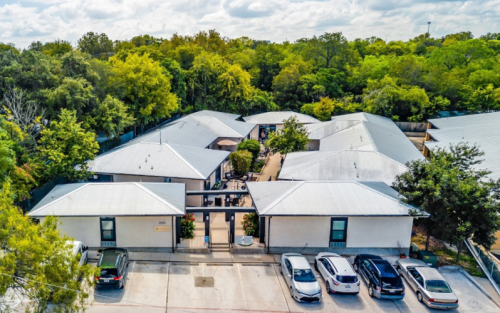
The current primary residential page describes apartment-style living, shared rooms and a courtyard community setting. The secondary listing instead describes a private bedroom within a two-person, same-gender apartment. Because those descriptions differ, this profile does not present private-bedroom accommodation as established. Ask admissions to identify the actual unit, bedroom and bathroom occupancy and to explain any private option or additional charge.
The provider describes its campus as having forty beds. That is a provider-published capacity description, not an independently verified licensed count or a statement of current availability. Ask about the unit proposed, how roommates are assigned and whether room arrangements change between detoxification and residential care. An apartment layout or courtyard photograph does not establish how much space or privacy an individual will have.
The residential page says meals are prepared onsite by a chef and mentions fitness opportunities away from the campus, including CrossFit. Discuss dietary requirements, allergies, accessibility and any assistance with daily tasks before arrival. Ask what activities are currently scheduled, who supervises transport and what alternatives are available. A fitness option should not be treated as appropriate for everyone or available without clinical clearance during every phase of care.
Family contact and the right telephone number
The provider’s About page describes family involvement and alumni support. Ask how family sessions are arranged, what the resident wants shared and whether there are separate educational options for relatives. Family participation in a care plan is different from unrestricted visiting or access to clinical information. Confirm the current phone, device and visitor rules for the relevant phase before relatives make travel or communication plans.
The website uses separate contact numbers for reaching current clients, including differing numbers in its footer sections. The older number previously displayed in this directory, 726-888-7003, appears in that current-client context. New applicants can start with the main contact-page number and ask for admissions. Families seeking an existing resident should confirm the appropriate contact process with the team rather than assuming that the initial enquiry number directly reaches the person.
Outpatient care and housing after the residence
New Choices describes its own partial hospitalization, intensive outpatient and outpatient services and says outpatient counselors can become involved while a person is still in residential care. When comparing outpatient options, ask for the actual timetable, clinical location and handover process. A relationship with the same organization can support continuity, but it does not eliminate the need for a new assessment, authorization or financial agreement when the level changes.
The About page describes day programming while a participant lives at home or in sober living, and shorter outpatient schedules as ordinary responsibilities resume. Ask who provides any proposed housing, whether it is separately billed and how transport is arranged. Do not assume a residential room remains available throughout outpatient care. If the person returns to another region, ask how local appointments and medication responsibilities will be established there.
Duration and the thirty-day price reference
The current residential page describes programs lasting thirty to ninety days. Ask for the recommended initial duration, how progress will be reviewed and what happens if a different length or level becomes appropriate. Clarify whether any initial detoxification period is included in the same commitment. The general range should not be read as a guarantee that all options are equally suitable or funded for the individual.
Recovery.com checked October 20, 2026 lists an estimated USD 26,000 for thirty days. This is a defined-duration third-party program reference rather than an official monthly tariff. It does not establish the cost of a sixty- or ninety-day plan or prove that every medical and accommodation expense is included. Request the actual service, duration, unit, room and inclusions in a current written offer.
The offer should distinguish detoxification, residential days, outpatient care, medication, tests, consultations, meals, transport, activities and any later housing. Confirm deposits, cancellation, early departure, transfer and extension terms. If a room arrangement or clinical recommendation changes, ask how the price changes with it. Keeping the proposed care and the financial agreement aligned is particularly important when a program offers several stages under the same name.
Insurance and practical discharge planning
The current insurance page says New Choices works with many carriers, including TRICARE East, but does not work with Medicare or Medicaid. It also mentions possible cash-pay arrangements and occasional reduced-fee scholarships. None establishes eligibility, availability or approval for a particular applicant. Ask for a policy-specific review naming the service, network relationship, authorization requirements and personal costs, and confirm any separate funding offer in writing.
Before a transition or discharge, request named follow-up appointments, a medication plan, appropriate accommodation and agreed responsibilities for communicating with the next clinician. Alumni contact and weekly community meetings can complement those arrangements but do not replace booked care. The decision about New Choices should rest on clinical fit, understood shared accommodation, a realistic schedule and duration, transparent costs and a practical next stage.
Sources checked October 20, 2026: New Choices’ current residential, contact, About, homepage and insurance pages; Recovery.com for the attributed thirty-day estimate and conflicting older bedroom description. The shared-room primary description takes precedence, and current-client telephone numbers are distinguished from admissions enquiries.
Destinations
Conditions
Levels of care
Settings
Program approach
Individual/group counseling, CBT, DBT, REBT, trauma-focused care, assessed medication-assisted treatment, twelve-step and SMART Recovery options, experiential activities, veteran-focused support, family work and continuing-care planning
Fees & admissions
Estimated USD 26,000 / program
Recovery.com checked October 20, 2026 lists an estimated USD 26,000 for thirty days. This is a third-party program reference, not an official monthly tariff or the confirmed price of a sixty- or ninety-day course. Request exact detoxification and residential stages, unit/room, clinical services, medication, tests, meals, activities, transport, outpatient care and any later housing in a written offer.
Confirm the current program, duration, accommodation and included services directly with the center.
Adults eighteen-plus. Confirm initial level, detoxification and medical resources, current medications and psychiatric needs, shared apartment/bedroom/bathroom allocation, access/diet needs, individual schedule and veteran-track availability, current contact/device/visitor policies, duration, itemized fees and policy benefits, and named outpatient/housing arrangements.