
About Guardian Recovery — Princeton Detox & Recovery Center
Princeton Detox & Recovery Center in Monmouth Junction
Guardian Recovery’s Princeton Detox & Recovery Center lists its receiving address as 4287 US-1 in Monmouth Junction, New Jersey. The Princeton name should not be read as an address in downtown Princeton. Its current website describes medically supervised withdrawal management and live-in residential addiction treatment, supported by the wider Guardian network. Confirm the actual building, treatment phase, and receiving team before arranging travel, particularly when discussing another Guardian program through the same admissions service.
The residential service focuses on substance use and associated mental health concerns in a structured living environment. The provider uses inpatient terminology, while Recovery.com describes a home-style, non-hospital setting. Neither wording alone establishes an acute psychiatric hospital admission. Ask what medical and psychiatric needs the proposed placement can manage, what would require outside stabilization, and which clinician makes that decision. An admissions inquiry should result in an individual clinical assessment rather than an automatic placement based on a diagnosis label.
Assessment, detoxification, and medical support
The current FAQ describes detox as involving medical assessment, monitoring throughout the day and night, and medication when appropriate. It gives a general three-to-ten-day range while acknowledging that the substance, previous use, and individual health can change the course. The FAQ also says medical and nursing staff are available around the clock. Ask which professionals are physically present during the proposed phase, who prescribes, and how urgent concerns or hospital transfers are handled.
Before admission, discuss current prescriptions, previous withdrawal experiences, physical conditions, psychiatric symptoms, and the records that the team needs. The provider says existing medication is reviewed and managed by its medical staff, with medication-assisted treatment available when appropriate. Confirm the plan for any medication already prescribed and how it will be coordinated with outside clinicians. Detox duration and the decision to move into residential therapy should follow assessment; neither a directory price nor a general timeline is a self-directed withdrawal plan.
Residential length and the daily timetable
The provider’s current pages give different general stay references. Its residential page describes approximately twenty-one to twenty-eight days, while the broader FAQ says thirty to ninety days is typical. These references do not establish a single required commitment. Ask which initial duration applies to the proposed program, whether detox is separate, how progress is reviewed, and what may change the discharge date. Distinguish the clinical recommendation from the period an insurer has actually authorized.
The residential timetable combines group work, individual appointments, recovery education, meals, movement or recreation, evening programming, and personal time. The sample schedule places individual therapy at one to three sessions weekly, rather than promising an individual psychotherapy session every day. Psychiatric appointments and case-management work are additional elements when indicated. Request a current timetable for the receiving unit, including weekends, the length of appointments, and any adaptations during early stabilization or for physical-health needs.
Therapies and co-occurring conditions
Current program information describes CBT, DBT-informed skills, motivational interviewing, trauma-informed care, twelve-step facilitation, and individual treatment planning. Group topics include coping skills, relapse prevention, communication, and relationships. Ask how the team selects methods for the person’s needs, who delivers them, and how progress is discussed. A list of available approaches does not mean every resident receives every method or that all scheduled activity counts as psychotherapy with a licensed clinician.
The provider discusses integrated care for substance use alongside concerns such as depression, anxiety, trauma, and other psychiatric symptoms. Its residential page describes psychiatric evaluation and medication management within that plan. Confirm whether the specific presentation can be treated here and whether a primary mental health placement without a substance-use need is available at the actual receiving unit. Yoga, mindfulness, creative activities, and recreation are described as complementary work; clarify their current schedule and any individual participation limits.
Teen treatment information requires a specific placement discussion
The website now also promotes an adolescent residential pathway, describing clinical supervision, individual and group therapy, family participation, psychiatric support, and academic coordination. Its teen page gives a general twenty-one-to-twenty-eight-day stay reference. However, the reviewed page does not clearly identify the eligible age limits or a distinct receiving unit and address. Families should obtain those details before assuming that the adult program description, its rooms, or its daily price applies to a teenager.
For an adolescent inquiry, ask about the age group, peer mix, guardian involvement, consent, communication, educational arrangements, and the clinical team’s experience with the relevant needs. Confirm whether schooling means coordination with the existing school, structured study time, or another arrangement, and who manages records and credit. The wider Guardian network also contains a separately named adolescent center. Request the actual program name and address in writing so that a network referral is not mistaken for a confirmed Monmouth Junction admission.
Bedrooms, shared spaces, and everyday arrangements
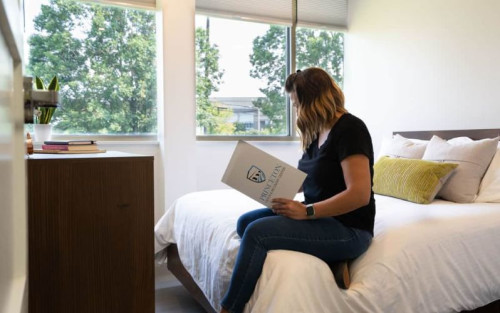
Room descriptions differ across the reviewed sources. The current FAQ and Recovery.com describe sharing with one to three other residents. The residential page advertises private or one-roommate accommodation depending on capacity and preference, with bathroom arrangements varying by facility. Private accommodation is therefore an advertised possibility, not a guaranteed room allocation. Ask for the precise bedroom, number of occupants, bathroom sharing, additional charge, and whether the assignment changes between detox and residential care.
Recovery.com describes lounges, an outdoor patio, and a cafe with prepared meals; the provider FAQ describes three meals and snacks with dietary needs considered. Discuss allergies, mobility, sleep requirements, laundry, and help with daily activities directly. The FAQ says phone and email use may be limited to designated times, with electronics rules changing by phase. Obtain the current packing list and device, visit, and work policies rather than assuming unrestricted access to a phone or laptop.
Family participation and communication
The dedicated family-therapy page describes work on communication, trust, boundaries, and the effects of substance use on relationships. A family therapist may work with the resident and appropriate loved ones to prepare for continuing recovery. Ask how participants are selected, how the resident’s agreement is handled, and what number and format of sessions the proposed plan includes. Family education, ordinary progress updates, visits, and a scheduled therapy appointment are different services and should be discussed separately.
The general FAQ says visits usually follow an initial stabilization period and vary with the treatment phase. Confirm the current rules before relatives book travel. Agree on the main contact, the information that may be shared, and how concerns can be raised. Family involvement should reflect the person’s circumstances and clinical plan. If remote participation is needed, ask whether it is available for the relevant session and how scheduling will work for people outside New Jersey.
Day treatment, outpatient care, and the Guardian network
The website describes partial hospitalization as five to six hours of treatment daily, usually five to seven days a week, with living arrangements outside the daytime clinical schedule. It also describes IOP as typically three hours daily on three to five days weekly. Home, program-associated accommodation, and sober living are discussed as possible arrangements. These are provider descriptions of its wider continuum; ask which exact service, address, staff, and accommodation are proposed after the residential stay.
The site explicitly presents continuing care across Guardian facilities and also advertises virtual options. A shared brand does not establish that every phase takes place at US-1 or that the same clinicians will remain involved. Confirm the receiving team, eligibility, schedule, transport, medication follow-up, and whether separate housing is required. If treatment continues online, establish the service’s availability where the person will actually be living and how local clinical or urgent needs will be addressed.
Separate detox and residential daily prices
Recovery.com lists estimated cash-pay rates of US$1,000 per detox day and US$970 per residential day. These are secondary estimates for different phases, not an official combined package. The provider’s self-pay page discusses funding and payment options without a verified numerical tariff. Obtain a written offer for the assessed sequence and actual dates. Do not apply the lower residential rate to detox or assume that either general stay range determines the total cost.
Ask the offer to separate accommodation, therapy, medical and psychiatric appointments, medication, laboratory work, outside care, transport, and optional services. Clarify any private-room supplement, extra days, deposits, cancellation, early departure, and refund rules. For insurance, confirm the exact policy, service, network status, authorization, deductible, and personal responsibility. A benefits inquiry is not a guarantee of payment. Payment-plan advertising likewise requires individual terms, while later outpatient care and housing should be priced separately.
Admissions and support after discharge
The current official contact page lists admissions at 888-693-1769 and the Monmouth Junction office at 609-554-5389. Discuss clinical suitability, withdrawal needs, psychiatric support, prescriptions, the proposed age group, accommodation, and funding before arranging arrival. Ask for confirmed acceptance, the receiving address, arrival contact, initial schedule, and financial agreement. The website’s suggested rapid admission window remains dependent on medical clearance and availability; it should not be treated as a reserved bed.
Guardian’s alumni page describes meetings, social activities, educational workshops, online connections, and referral support for people who completed its programs. Ask which events and contacts are currently available locally or remotely. Alumni participation does not replace an agreed clinical follow-up plan. Before discharge, identify the next appointments, prescriptions and prescriber, records transfer, local support, and any housing arrangement. Compare Princeton using the actual receiving program, medical resources, room, phase-specific fees, and continuity of care.
Sources and further comparison
Source review: October 20, 2026. Official contact and Monmouth Junction address; Official FAQ on medical support, stay and shared rooms; Residential program, timetable and accommodation alternatives; Provider-described adolescent residential pathway; Partial hospitalization and the wider care continuum; Family therapy; Guardian alumni program; Official self-pay information without a numerical tariff; Recovery.com separate daily fee estimates and campus description. Provider statements describe the advertised service; they do not establish an individual admission decision, current availability, or treatment outcome. Price evidence is identified separately from the provider’s own fee policy.
For a broader comparison, explore treatment options in the United States and read questions to ask a treatment center. Use the answers from the actual receiving team to compare the clinical plan, practical arrangements, and written financial terms.
Destinations
Conditions
Levels of care
Settings
Amenities
Program approach
Medical and psychiatric assessment, medication treatment when appropriate, individual and group therapy, CBT/DBT-informed skills, motivational interviewing, trauma-informed work, twelve-step facilitation, family participation, complementary activities and continuing-care planning
Fees & admissions
Estimated USD 970 / day
Recovery.com checked October 20, 2026 estimates USD 970 per residential day and separately USD 1,000 per detox day. These are third-party references, not an official tariff or combined package. Confirm assessed sequence and actual dates, room supplement, medical and psychiatric work, medication, tests, transport, outside care, extensions and later treatment or housing in a written offer.
Confirm the current program, duration, accommodation and included services directly with the center.
Confirm exact age group and receiving unit, medical/psychiatric and withdrawal suitability, prescription plan, room and bathroom, staffing, duration, family/education needs, itemized phase-specific fees and payer authorization. PHP/IOP, virtual and alumni services are described across Guardian; establish the actual location and living arrangements.