
About Bedrock Recovery Center — Canton
Bedrock Recovery Center in Canton
Bedrock Recovery Center is located at 1 Meadowbrook Way, Canton, MA 02021, in the greater Boston region. Its official website describes a 160-bed facility with separate detox, residential addiction, and primary residential mental health services. The distinction between those programs matters when comparing treatment: a bed at the same property can involve a different clinical plan, team, admission process, and price. This profile is included in the United States treatment directory under the actual Canton location.
The larger campus setting offers a different residential experience from a small treatment house. Ask which unit the person would join, how many people share its groups and common areas, and how staff are assigned. A total bed count does not establish the size of the treatment group or the attention a resident receives. The useful comparison is the specific program proposed for the individual, including its staffing, daily schedule, accommodation, and transition into continuing care. Confirm those details before arranging travel to Canton.
Choosing the relevant program
Bedrock describes medical detox, residential addiction treatment, and a primary mental health program. These should be discussed separately during assessment. Someone seeking help for mental health concerns without a substance use disorder may need a different pathway from a person entering withdrawal support. A person with co-occurring concerns needs to understand how the two parts of care are coordinated. Explain current symptoms, substances where relevant, prescribed medicines, and recent treatment so the team can clarify which service is appropriate.
Ask whether the recommended program takes place on the same unit throughout the stay and how a change of care level is handled. Sharing a campus does not necessarily mean that every appointment, staff member, or room remains the same. The provider should explain who coordinates the plan and how information is handed over between teams with consent. This is especially useful if the person has previously found transitions difficult or is entering Bedrock from another facility rather than directly from home.
Medical detox and ongoing treatment
The provider describes medically supervised detox and medication options for addiction treatment. Ask which clinician reviews the person’s history before admission and what evaluation happens on arrival. Provide accurate information about current substance use, prescribed medicines, relevant health conditions, and previous withdrawal experiences. The assessment should explain whether the facility can meet those needs or whether another setting is required first. Do not treat an advertised detox package as a fixed medical timeline or change a prescription to match a booking.
If medication is part of the proposed plan, discuss who prescribes it, how follow-up is arranged, and what happens after discharge. Bedrock describes a coordinator for patients interested in medication-assisted treatment. That role can be explored in practical terms: how existing prescriptions are reviewed, how the resident participates in decisions, and who connects the plan to the next clinician. A directory should not select a medicine or imply that the same treatment is suitable for everyone; those decisions require individual clinical assessment.
Residential addiction treatment
The official residential treatment page describes assessment, structured daily care, individual and group therapy, family involvement, and discharge planning. Ask how those elements are organized for the proposed admission. Clarify the frequency of scheduled individual appointments, how groups are formed, and how mental health needs are addressed alongside substance use. The plan should connect each component with a goal the resident understands, rather than relying on a general list of treatment methods.
Bring practical priorities to the assessment. Someone might want help understanding patterns around use, dealing with difficult situations at home, rebuilding a daily routine, or preparing for a return to work. Those concerns can inform therapy and discharge planning. Ask how goals are recorded and reviewed with the resident and whom to approach if a part of the program is not useful. A structured setting still needs a clear way for the individual to discuss preferences, concerns, and changes in their needs.
Primary mental health care and co-occurring needs
Bedrock’s primary residential mental health service should be distinguished from mental health support within an addiction program. Ask what the proposed admission is intended to address, which clinicians are responsible, and how psychiatric review is scheduled. Bring relevant records and explain current treatment, including any existing therapist or prescriber. A broad diagnosis list does not establish that every person or level of acuity is suitable for a residential unit. The clinical team should explain its admission criteria and any needs that require another service.
Discuss how the program coordinates physical health concerns as well as psychological treatment. Ask which services are onsite, how outside appointments are arranged, and what happens if a more intensive medical response is needed. The residential mental health label should not be read as a guarantee of the same capabilities as every acute psychiatric hospital. For someone transferring after hospitalization, the two services should agree the handover and the plan for continuing medication and appointments before the person leaves the sending facility.
Rooms, shared spaces, and campus life
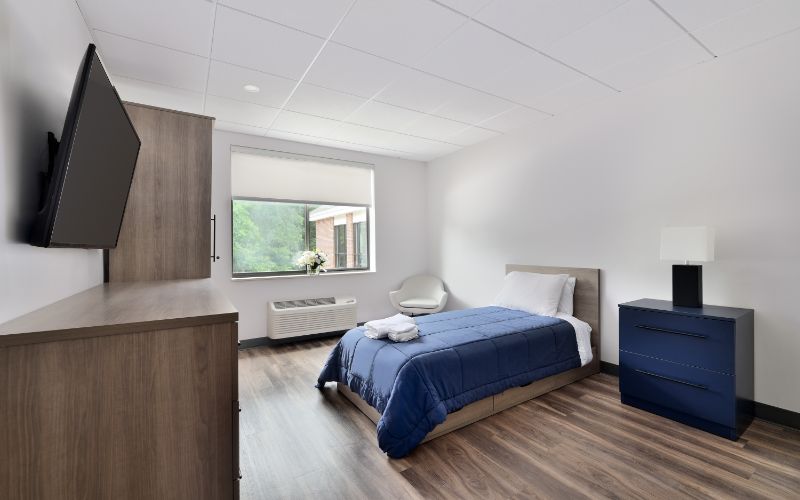
The official site describes semi-private suites, meals, fitness facilities, outdoor space, and a movie theater. The Recovery.com listing also mentions private-room options, but current availability and the relevant unit need confirmation. Ask which bedroom and bathroom arrangement is included in the proposed stay, whether a preference costs more, and whether a room allocation can change. A photograph or general property description does not establish the exact accommodation offered for each treatment program.
Consider how the campus works for everyday needs. Ask about accessibility, distance between living and treatment areas, meal arrangements, dietary requirements, laundry, and storage of belongings. A larger property may have several common spaces and schedules, so it is useful to understand the resident’s actual routine. Clarify quiet time, visitors, phones, and computer access. If the person needs support with movement, fatigue, or another daily task, discuss it before admission so that the response addresses the practical circumstances.
Special interests and support from others
Bedrock advertises programs or tracks for several communities, including union members, veterans, first responders, and LGBTQ+ individuals. Ask what a relevant track actually adds to the proposed care: a dedicated group, a clinician with particular experience, practical support, or a separate admission arrangement. A named population should not be assumed to have a completely separate unit or guaranteed place. The resident can explain what matters to them without assuming that an occupational or personal identity tells the team everything about their treatment needs.
Ask how family or chosen supporters can participate with the resident’s consent. A relative may need education, a joint session, or help planning the return home, while an existing clinician may need to exchange records. These are different roles. Clarify who delivers any family service, whether it is included in the package, and how remote participation works where available. Supporters can assist with practical responsibilities without taking over decisions that belong to the patient and clinical team.
Two different secondary price estimates
At the October 20, 2026 review, Recovery.com listed US$10,000 for a full medical detox package and US$40,000 for a 28-day residential stay. These are separate secondary estimates for different services, not a single interchangeable US$10,000–US$40,000 range. Neither figure is presented as a tariff independently confirmed by Bedrock. Ask for a current written quote stating the actual program, expected duration, room arrangement, and included professional services. Confirm whether the person would need one stage, both, or a different sequence.
The official website describes a thirty-day residential addiction program, while the secondary price uses twenty-eight days. Preserve that difference when requesting a quote. Do not assume a twenty-eight-day estimate automatically includes thirty days or that a detox fee can be added without checking the package terms. Ask how additional days are priced and who authorizes an extension. A primary mental health admission may also have different financial arrangements, so an addiction-program estimate should not be applied to it without confirmation.
If using insurance, request a benefits review for the exact program and policy. Clarify authorization requirements, deductible, coinsurance, and any services billed separately. A provider’s general statement that it accepts insurance does not establish what the individual will owe. Ask which part of the financial estimate has been verified and what remains conditional. If another person or organization is contributing, agree who is responsible for payment and what information can be shared, separately from the resident’s clinical consent.
Length of stay and changes to the plan
Clinical recommendations, insurance authorizations, and package durations can differ. Ask how often the team reviews the plan and how the resident takes part in that discussion. If more time is recommended, request an explanation of the clinical goals and the financial effect before assuming an extension is arranged. If another level of care is appropriate, establish where it will take place and who coordinates the transition. A clear review process is more useful than treating an initial estimated discharge date as fixed.
Before admission, clarify cancellation, early departure, deposits, and payment for outside services. Ask what happens financially if the person needs transfer to another setting. These terms should be understandable alongside the clinical plan. Keep a copy of the written proposal so that the resident and any payer are referring to the same program and duration. Comparing the actual components of a stay makes more sense than comparing headline amounts that describe different care levels or lengths.
Aftercare and the next treating team
Bedrock describes an aftercare coordinator who helps connect residents with continuing services. Ask when that work begins, which appointments can be arranged before discharge, and how records are shared with consent. A resident returning outside Massachusetts may need different arrangements from someone staying near Canton. Identify the next therapist or prescriber, any medication follow-up, and the support available between appointments. Alumni contact, peer support, and clinical treatment should be distinguished so that each has a clear role in the return-home plan.
The official inquiry number is (617) 657-2877. A useful first conversation identifies the appropriate Bedrock program, the actual unit and accommodation, the clinical team, and the written financial terms. Follow that with questions about the transition after the stay. The range of services at one Canton campus provides several possible pathways; the decision should rest on the specific plan offered to the individual and how clearly it connects assessment, treatment, and continuing care.
Destinations
Conditions
Levels of care
Settings
Amenities
Program approach
Clinical assessment, individual/group therapy, co-occurring care, family involvement, medication options and aftercare coordination
Fees & admissions
Estimated USD 40,000 / program
Recovery.com estimates checked 2026-10-20: USD 40,000 for 28-day residential stay; separate USD 10,000 full medical detox package. Different services, not a USD 10k–40k range. Provider describes 30-day residential program; request exact current quote for actual duration/program.
Confirm the current program, duration, accommodation and included services directly with the center.
Confirm exact program/unit, clinical eligibility, room arrangement, authorized duration, financial terms and continuing-care handover