
Care at Camino Recovery
Camino Recovery: residential care for addiction, trauma, and related difficulties
Camino Recovery is a family-run residential treatment center in Vélez-Málaga, Andalucía, in southern Spain. Its elevated property looks toward the Mediterranean and the Tejeda Mountains and contains seven individually designed suites with private en-suite bathrooms. The provider offers stays of 30 to 90 days for addiction, trauma, and co-occurring mental health difficulties. Individual therapy, small-group work, a substantial family program, and equine-assisted psychotherapy are prominent parts of its approach. The setting provides personal space, while treatment takes place within a shared residential community.
The current provider overview identifies alcohol, drugs, prescription medication, and behavioral addiction concerns among the problems treated. It also discusses trauma and mental health difficulties such as depression, anxiety, OCD, ADHD, and bipolar disorder. These published areas of work do not replace an individual suitability assessment. A person may need a different level of medical or psychiatric care before entering a residential program, and the team should consider the full history rather than decide from a diagnostic label alone.
Assessment and the important distinction around detox
Camino recommends a professional assessment with its clinical team before admission. The purpose is to identify the appropriate treatment plan and length of stay, with further reviews during the program. The initial discussion should cover recent substance use, current medication, physical health, psychiatric symptoms, previous treatment, and the practical support available at home. These details help the team decide whether the residential setting is suitable and which issues need attention first. They also allow the patient to understand the proposed work before making travel arrangements.
The provider’s current FAQ states that, when medical detoxification is necessary, Camino collaborates with a trusted local provider before residential treatment begins. This is a material distinction: the seven-suite residential property should not be described as providing its own on-site medical detox unit. Someone likely to need withdrawal care should confirm where that care will take place, who oversees it, how the handover works, and whether it is included in the quoted fee. The sequence should be agreed before traveling to Spain.
The clinical team and individual treatment
The published clinical team includes consultant psychiatrist Dr. José Manuel Sánchez and consultant doctor Dr. Rafael Campos Clouté. Don Lavender is listed as program director, Ameet Braich as clinical director, and Meena Lavender as a director and family therapist. The directory also identifies clinical psychology, DBT, art therapy, clinical support, and wellness roles. These are provider-published positions at the time of review; the assessment should clarify which professionals will be responsible for the individual’s care and how often they will meet.
Camino’s individual therapy description distinguishes focused work on a particular concern from a deeper examination of recurring patterns. The stated goal is to support change and independence rather than create long-term dependence on the therapist. A patient can use the assessment to identify what they most want to address and how progress will be recognized. The public page does not promise a fixed number of individual sessions each week, so the actual schedule should be included in the treatment proposal.
CBT, DBT, and trauma-focused work
Cognitive behavioral therapy is described as one component of Camino’s integrated program. Its published approach focuses on identifying recurring thoughts and behaviors and working toward practical goals. This can be connected with the patient’s own examples, such as responses to stress, conflict, or situations associated with substance use. The provider presents CBT alongside other methods rather than as a uniform course delivered identically to every resident. The treatment plan should explain the reason for selecting it and how the work will be practiced between sessions.
The center also offers dialectical behavior therapy, with attention to mindfulness, distress tolerance, emotional regulation, and interpersonal effectiveness. The team directory names a DBT therapist, which gives more context than a therapy label alone. However, the general description of DBT on the website should not be read as a guarantee of a particular full program, telephone-coaching schedule, or session frequency. Someone already receiving DBT can ask how residential work would connect with their existing treatment and what would continue after discharge.
Trauma work is central to Camino’s stated philosophy. Its EMDR service describes guided work with distressing memories, while the broader program includes other individual and group approaches. The appropriate timing and method depend on assessment and readiness. A patient should be able to discuss concerns about revisiting difficult experiences, previous responses to trauma therapy, and the support available between sessions. Provider descriptions of rapid relief or a particular mechanism should not be interpreted as a guaranteed outcome for every person.
Equine-assisted psychotherapy without horseback riding
Equine-assisted psychotherapy is one of Camino’s distinctive published services. The provider explicitly states that it does not involve riding horses. Instead, patients take part in structured activities and tasks with horses from the ground, with the interaction used as material for therapeutic discussion. The aim is to explore communication, reactions, relationships, and personal awareness through an experience that is not limited to conversation in an office. This distinction is useful for someone who is interested in the method but has no riding experience.
The activity should still have an individualized therapeutic purpose and appropriate supervision. A prospective patient can ask how equine work is selected, how it relates to their other sessions, and what alternatives are available if physical limitations or discomfort around animals make participation unsuitable. The presence of horses does not establish a predictable clinical result. What matters is the way a qualified therapist connects the experience with the person’s treatment goals and integrates any observations into the broader course of care.
Small-group work and the recovery community
Camino calls group therapy a central part of treatment. Its published formats include process groups, psychodrama, expressive work, psychoeducation, cognitive behavioral groups, and 12-step facilitation. These serve different purposes: some explore relationships and reactions, others provide education or practice with new ways of responding. Psychodrama uses role-based exercises, while expressive groups allow communication through creative activity. Patients should understand the proposed mix and how it fits with their individual sessions.
The center emphasizes small groups and mutual support, but a private suite does not mean treatment is exclusively one-to-one. Someone who finds group disclosure difficult can discuss how participation is introduced and what boundaries apply. The 12-step element should also be explained, especially if the person has strong preferences based on previous recovery experiences. The treatment overview notes that some timetable space can be adapted to the current group’s needs, so the available schedule should be confirmed for the planned admission.
A family program with access beyond current residents
Camino’s family program runs over four or five days. It is open to people affected by addiction or difficult patterns within a family, social, or work network; their loved one does not have to be attending Camino’s residential program. This makes it a distinct service as well as a possible component of a resident’s care. The published format includes educational sessions, process groups, personal goal-setting, reflection, and counselor-facilitated family conferences.
The family work addresses communication, boundaries, family systems, and the wellbeing of those supporting someone with an addiction. Its stated purpose includes helping relatives recognize what they can take responsibility for in their own lives. It should not be treated as an obligation to control another person’s recovery or achieve reconciliation on a timetable. When participation relates to a current patient, discuss consent, appropriate attendees, and how the family sessions connect with the individual’s treatment goals. Separate accommodation, travel, scheduling, and fees should be clarified before relatives book a visit.
Suites, dining, and the Andalucía setting
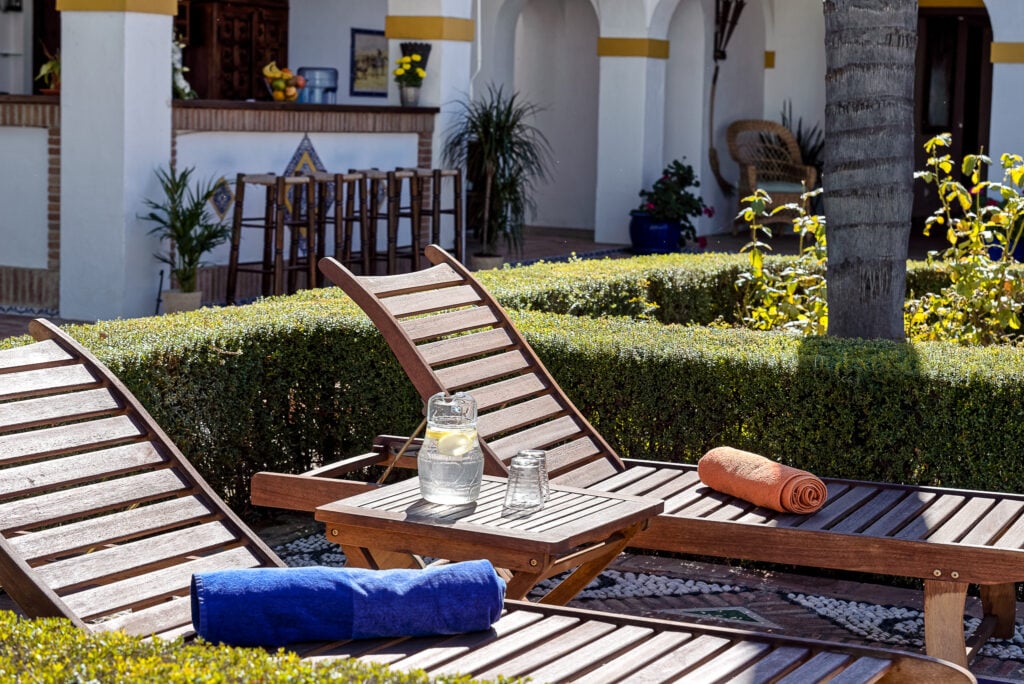
The facilities page describes seven private en-suite suites, each with its own design. Some have direct access to the walled gardens and pool, while others look toward the mountains, coast, and Vélez-Málaga’s historic fort. The property includes an outdoor pool, terraces, and shared dining areas. These are specific accommodation features rather than evidence of a particular treatment outcome. If a ground-level room, adapted bathroom, or easy access between buildings is needed, the exact room should be confirmed in advance.
Meals use fresh, locally sourced ingredients, and Camino says its chefs can adapt menus for cultural requirements and food intolerances. Discuss allergies or medical dietary needs with the team before arrival so they can confirm suitable arrangements. The provider places the center roughly forty minutes from Málaga International Airport. Actual journey time and transfer support depend on the arrangements made for the admission, particularly if a separate detox placement must happen first. A coordinated itinerary should reflect the clinical sequence rather than simply the flight schedule.
Recovery planning and the transition home
Camino uses the term recovery planning for its relapse-prevention work. The published description focuses on recognizing personal triggers, stressors, and warning signs and developing practical responses. It connects this with sleep, nutrition, activity, reflective practices, and a support network. The value lies in relating these areas to the person’s actual circumstances. A plan for someone returning to work and family responsibilities may look different from one involving further residential support or a move to a new living environment.
The main website describes aftercare support but does not publish a universal duration or number of included follow-up sessions. Before leaving, confirm the planned therapy appointments, medical or psychiatric reviews, and contact with clinicians in the home country. Ask what Camino provides directly and which services are arranged separately. The family program can help clarify shared expectations, but relatives should not become the substitute for required professional care. The transition plan should remain practical enough to follow once the structure of residence has ended.
Published fees and what to confirm
Camino currently advertises an all-inclusive rate of EUR28,500 for an initial 30-day residential stay. Its stated residential range is 30 to 90 days, with longer treatment based on clinical recommendation. The published figure is in euros and applies to thirty days, so it should not be relabeled as a weekly rate or an unspecified monthly estimate. Request the written inclusions for the proposed stay, including the individual therapy schedule, medical reviews, family participation, and any changes associated with a longer program.
The separately arranged detox pathway is especially important to clarify within the cost discussion. Ask whether local-provider fees, medication, transport, and any additional medical services are covered by the residential quotation or billed separately. The public materials reviewed do not establish automatic insurance coverage or a universal extension rate. Admissions should confirm the accepted funding method, payment schedule, and terms before travel. This allows the patient to assess both the clinical plan and the total commitment using the same clearly defined package.
Information checked October 20, 2026 using Camino Recovery’s official program, team, therapy, family, facilities, and admissions information. The published thirty-day rate and separate local-provider detox arrangement should be reconfirmed in writing.
Conditions
Levels of care
Settings
Amenities
Treatment approach
Individual and small-group therapy, CBT, DBT, EMDR, ground-based equine-assisted psychotherapy, family work, and recovery planning
Fees & admissions
EUR 28,500 / program
Official all-inclusive starting rate for an initial 30-day residential stay: EUR28,500. Longer treatment is assessed individually. Confirm all inclusions, family services, aftercare, and especially any separately arranged local-provider detox charges in writing.
Confirm the current program, duration, accommodation and included services directly with the center.
Confirm clinical suitability, any external detox requirement, suite, fully inclusive scope, specialist or medication exclusions, recommended duration and continuing-care plan