
Care at House of Life — Simi Valley
A six-place residential program in Simi Valley
The House of Life provides residential substance-use treatment and detox services in Simi Valley, California. Its website sometimes uses the wider Los Angeles market in its descriptions, but the address associated with this listing is 468 Alta Mira Street, Simi Valley. The current facility page describes six private beds in a small residential setting. The program combines addiction treatment with support for co-occurring mental-health concerns, individual and group work, and a range of wellness activities. It is a shared treatment community with private accommodation, rather than a program that reserves the whole property for one client.
The facility description identifies a service for men and women, while the state record reviewed describes an adult residential program. The practical fit depends on the person’s substance use, medical needs, emotional health, and readiness for the proposed setting. The size of the residence may influence the atmosphere, but it does not by itself establish the frequency of psychotherapy or the level of medical supervision. Before admission, the person should receive a clear explanation of the starting phase of care and how the individual plan will be delivered.
What the available credential records establish
The California Department of Health Care Services dataset reviewed for this profile identifies 1st House of Life Inc at the same Simi Valley address under number 560083BP. The August 17, 2026 dataset lists six treatment places, residential and detox services, and incidental medical services. This is useful evidence connecting the operator, address, and program scope. It does not turn the residence into an acute hospital. The certificate displayed on the provider’s credential page likewise describes a nonmedical adult residential program with detoxification and incidental medical services.
There is a date limitation to that evidence. Both the displayed certificate and the state snapshot show September 30, 2026 as the expiration date, while this review took place on October 20, 2026. The state dataset was last edited before that date, and the public certificate is an older document. These sources therefore do not verify renewal after September 30. This is not evidence that the service has closed or is operating without authorization. A prospective admission should include confirmation of the current credential covering the operator, address, and proposed services, rather than relying on the older image alone.
Assessment, detox, and medical arrangements
The admissions guide begins with a conversation about health, substance use, and previous treatment, followed by insurance review and a treatment recommendation. It describes medical pre-assessment as part of choosing the appropriate plan. This is the point to establish whether the person needs withdrawal management, residential therapy, or another service first. A generic description of detox should not replace an individual decision. The proposed placement should account for recent use, existing prescriptions, past complications, physical-health conditions, and the support required during the early days of care.
The detox page advertises medically supported withdrawal management, medications when appropriate, therapeutic support, and twenty-four-hour care. It lists programs relating to alcohol and several categories of drugs. These are provider descriptions of the service, not a statement that every withdrawal presentation can be managed in the residence. The public pages do not give a complete named physician and nursing shift roster. Confirm who will perform the assessment, who is present overnight, how medical concerns are reviewed, and when a transfer or outside appointment would be arranged.
The wider program presents detox as a transition toward continued treatment, rather than the whole recovery plan. That distinction matters when considering a short stay: the person needs to know what follows the stabilization phase and whether the proposed residential dates include it. The medical and therapy teams should agree on the next steps, including prescriptions, psychological support, and practical arrangements. The reviewed state category and provider descriptions support residential care with medical involvement; they do not establish acute hospital admission or a hospital ward at this address.
Psychotherapy and co-occurring care
The residential program describes cognitive behavioral therapy, dialectical behavior therapy, motivational interviewing, and trauma-informed work. These methods are presented as parts of an individualized plan informed by the person’s history and circumstances. The site also mentions EMDR, somatic approaches, psychodynamic work, and family therapy. A prospective resident should understand which interventions are actually recommended and how much individual contact is planned. A list of available methods should not be mistaken for a promise that every resident receives a complete course of each one during a single admission.
The current team page names Sareen Khodabakhsh, LMFT, as clinical director, with Julia Margaryan as chief executive and other personnel in counseling, case-management, and support roles. These listings help identify the organization, but they do not establish that every team member provides psychotherapy. The admission plan should distinguish the primary therapist, the person handling practical coordination, and the medical professional responsible for prescribing. It should also explain how they communicate when substance use, trauma-related distress, anxiety, or depression need attention together.
The program describes co-occurring care within substance-use treatment. That is different from establishing a separate primary psychiatric hospital pathway for every diagnosis appearing in marketing material. The initial assessment should determine what symptoms can be addressed in this setting and whether another level of psychiatric care is needed. The work also needs to connect individual sessions with the residential groups. Educational groups, shared discussion, and experiential activities serve different purposes, and the person should know how each contributes to the goals established with the clinical team.
Medication support as part of the plan
The House of Life advertises medication-assisted treatment alongside counseling and behavioral work. Its residential page mentions buprenorphine and naltrexone-related options, while the medication page discusses a broader range of treatments in general terms. The appropriate medication, prescribing responsibility, monitoring, and follow-up require an individual medical decision. A medicine discussed on an educational page is not necessarily dispensed on site or suitable for every resident. In particular, the review does not establish that the Simi Valley house operates its own opioid treatment program simply because the page explains methadone.
The duration of medication care also needs to be distinguished from the duration of the residential booking. A thirty-day accommodation quote does not establish when a prescription should start, change, or stop. The discharge plan should identify the next prescriber, the timing of appointments, and how the person will obtain any continued medication. Those arrangements are especially relevant when someone travels from another state. The clinical discussion should focus on continuity and individual need rather than assume that all treatment finishes when the paid residential days end.
Accommodation and the daily environment
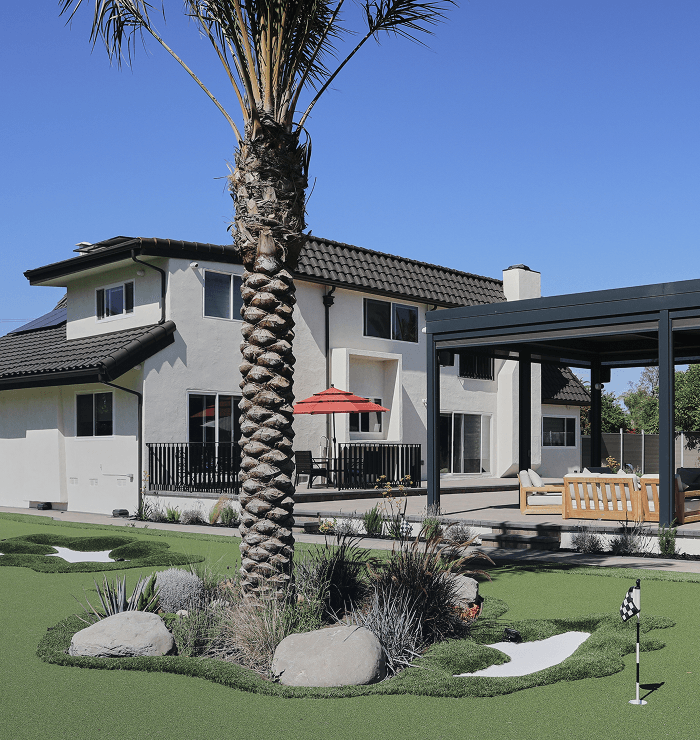
The current facility page advertises six private beds, a pool, courts for pickleball and basketball, and a compact ten-hole golf area described as approximately 12,000 square feet. It also lists a spa, sauna, steam room, cold plunge, and a space for reflection near a waterfall. These details describe the provider’s recreational setting, not a full-size golf resort or exclusive use of each facility. The actual room, bathroom arrangement, accessibility, and any additional accommodation charge should be confirmed. The six-place capacity is supported more directly than the smaller occupancy range still shown in the secondary directory.
The residential description combines scheduled therapy with meals, community activities, personal reflection, movement, and creative work. It lists options such as yoga, art, music, gardening, and guided outdoor activities. These can give variety to the stay, but the page does not establish that every activity runs daily or that all options are appropriate for every person. A client with mobility limits, sensory needs, or dietary requirements should have those arrangements addressed before arrival. The recreational environment supports the residential experience; it does not replace the need for a clear clinical schedule and competent supervision.
Family involvement and practical admission details
The official residential material describes family therapy, boundary-setting work, and planning communication after treatment. The practical form of that involvement should reflect the resident’s consent and circumstances. Relatives need to know whether a planned contact is a clinical session, an educational meeting, or a visit, and whether remote participation is possible. Current visitor, phone, and device policies are not fully specified in the reviewed pages. A private room or internet-related amenity should not be treated as unrestricted permission for calls, work, or visitors throughout the day.
The admissions page offers travel assistance for people coming from outside the state, but the exact transport and any associated charge should be agreed directly. Recovery.com describes additional conveniences and animal-related accommodations; those are secondary claims that should be checked for the particular admission rather than treated as universal policies. Before traveling, obtain the arrival address, room confirmation, packing and medication instructions, and a direct contact for delays. The current official provider number is +1 805 888 8000, replacing the directory-tracking number previously shown in this profile.
Thirty-day pricing and continuing care
Recovery.com lists an estimated cash-pay cost of USD 40,000 for thirty days. That is a third-party program estimate checked on October 20, 2026, not an official monthly tariff. The provider’s own pages direct people to discuss payment and insurance with admissions. A written quote should identify whether the thirty days include detox, the assigned room, medical and psychiatric appointments, medication, outside services, transport, and any extension. The final insurer contribution and patient responsibility need confirmation for the individual policy and admission.
The official material refers to individualized aftercare and mentions outpatient options, but the reviewed credential evidence does not establish a separate outpatient clinic operating at the same address. The transition plan should therefore identify the actual next provider, location, appointments, prescriptions, and payment arrangements. When comparing House of Life with other treatment programs in the United States, its small residential format, private-bed offer, and documented detox-related scope are relevant. Current credential confirmation, the assigned clinical team, and a written treatment and financial plan remain essential details for the proposed stay.
Conditions
Levels of care
Settings
Amenities
Treatment approach
Individual and group counseling, CBT, DBT, motivational interviewing, selected EMDR/somatic and psychodynamic work, family therapy, psychiatric assessment and medication support when indicated, creative and wellness activities, and individualized continuing-care planning
Fees & admissions
USD 40,000 / program
Recovery.com third-party estimated cash-pay rate checked October 20, 2026: USD 40,000 for thirty days. This is a program reference, not a provider-published monthly tariff. Confirm whether detox days are included, the actual room, medical and psychiatric appointments, medicines, outside care, transport, extensions and insurance responsibility. The official admissions pages direct financial questions to the provider and do not establish universal full insurance coverage.
Confirm the current program, duration, accommodation and included services directly with the center.
Confirm the current credential for operator 560083BP and the Simi Valley address, medical and withdrawal suitability, assigned clinicians and overnight support, actual private bedroom/bathroom, individual dates and fee, authorized family/device arrangements, insurance and a named next-stage provider.