
Care at NEOVIVA — Vitznau
A residential clinic within a working hotel
NEOVIVA provides residential addiction treatment in Vitznau, Switzerland, with its clinic located in a private wing of a hotel overlooking Lake Lucerne. The arrangement combines private clinical spaces and sleeping accommodation with access to ordinary hotel facilities. Other hotel guests use shared areas. This is a deliberate part of the provider’s treatment model and an important distinction from an exclusive-use villa or a closed residential estate.
The setting may appeal to someone who wants to practice everyday routines while receiving structured support. It also calls for a careful discussion of privacy, contact with other guests, and clinical suitability. Ask the team how the hotel environment fits the individual’s needs, which areas are reserved for treatment clients, and how support is available during shared activities. Booking a hotel room alone is not an admission to the clinical program.
The focus of the Signature Programme
The provider’s Signature Programme addresses addiction and related psychological difficulties through individual psychotherapy, psychoeducation, psychiatric and medical input, and practical recovery work. The professional-referral page describes adult and young-adult clients with substance use, behavioral addictions, and co-occurring concerns. The actual assessment must establish suitability. A broad list of conditions does not establish that every presentation, age, or level of medical need can be supported here.
Ask the clinical team to explain the main goals of the proposed stay and how those goals connect with previous treatment. If several problems overlap, clarify which will receive priority and who will coordinate them. Existing clinicians can provide useful information where the person consents. The resulting proposal should make clear why this particular residential and hotel-based model is recommended, including any preliminary care or alternative setting that is needed.
Medical evaluation and detoxification arrangements
NEOVIVA’s fee information identifies a mandatory medical check-up that is charged in addition to the weekly treatment rate. Its professional-referral page describes evaluation at a partner hospital. The admission and treatment FAQs say that people needing around-the-clock medically managed detoxification are referred to a partner clinic before beginning the NEOVIVA program. The precise location and sequence must be agreed following assessment.
The professional-referral wording also refers to detoxification where appropriate, so ask the receiving clinicians to identify explicitly which service delivers each stage and where it occurs. Do not infer a full hospital-level withdrawal service from the availability of medical professionals to the residential team. Confirm the clinical handover, transport, separate charges, and what would happen if initial care took longer than expected. Those answers should be settled before treating a provisional arrival date as final.
Individual psychotherapy and the wider timetable
The Signature Programme describes individual work with a key therapist alongside groups, recovery sessions, and regular reviews. NEOVIVA’s FAQ says the initial assessment helps determine the key therapist, while the wider team participates in care. Ask for the actual weekly schedule and the roles of the professionals involved. Private accommodation does not mean that all treatment takes place individually or that the same therapist delivers every component.
The program’s psychoeducation covers practical issues such as boundaries, emotional distress, and patterns connected with substance use. Discuss which of these areas is relevant to the person and how the work will be practiced between sessions. If a method or group format has previously been difficult, explain the experience and ask how the team would respond. A useful plan links individual goals, scheduled appointments, and day-to-day practice.
rTMS and complementary activities
NEOVIVA advertises repetitive transcranial magnetic stimulation, or rTMS, among its treatment methods, along with body-focused and complementary activities. These offerings should be considered through individual clinical assessment. Their presence in the program description is not a guarantee that a particular intervention is suitable, necessary, or likely to produce a specific outcome for every person. Ask the responsible clinician to explain the recommendation, screening, alternatives, and review process.
The public schedule also includes activities such as mindfulness, physical training, forest-based activities, and work involving horses. Clarify their purpose, supervision, availability, and place in the proposed timetable. A leisure activity, a wellness appointment, and a clinical intervention are different services. The person should be able to understand those differences and discuss alternatives if an activity does not fit their health needs, abilities, or treatment goals.
Recovery meetings and participation
The provider’s treatment FAQ describes recovery counselors accompanying clients to AA or NA meetings on some evenings. It distinguishes these meetings from professional treatment while including attendance within the program’s approach. Someone with a particular preference about peer support should discuss it during assessment rather than assume that the program is entirely separate from twelve-step fellowships. Ask how meeting participation is planned and what other support is available.
The hotel environment is also intended to provide opportunities to practice new responses in everyday situations. Ask how this is introduced, how difficult situations are reviewed, and what support is available outside formal appointments. The balance between autonomy and structure should be clear to the person entering care. Proximity to ordinary social settings is a meaningful feature of the model, but its suitability needs to be considered individually.
Rooms, shared hotel facilities, and practical needs
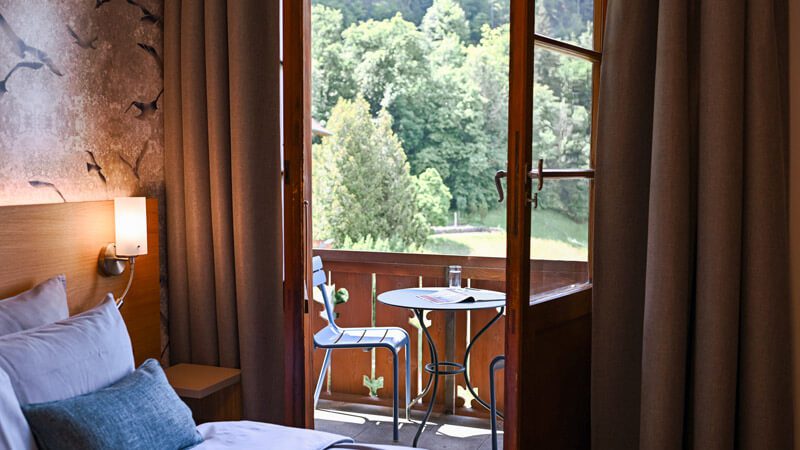
The published fee includes private en-suite accommodation and full board. NEOVIVA’s hotel page describes lake-view rooms and suites, with balconies in some rooms and all suites. Selected suites include office space. These are different room categories, so confirm the exact assignment and any additional price before assuming a balcony, separate office, or particular view is part of the offer. The clinical booking should identify the accommodation it includes.
The hotel has dining and wellness facilities, including a pool, saunas, and a small gym. Ask about access, supervision where appropriate, and how those facilities fit around treatment. Describe any mobility, bathroom, dietary, sensory, or sleep-related requirements in advance. If a family member or pet may accompany the person, discuss the actual policy and arrangements separately. A photograph or general hotel amenity description does not confirm availability for a particular stay.
Family involvement and staying connected
NEOVIVA advertises family-related services as part of its wider offer. Ask which involvement is recommended, who the resident wants included, and whether the proposed sessions take place in person or remotely. A family visit, a separate family program, and a joint clinical appointment may have different arrangements and prices. The resident’s consent and the intended purpose should be clear before invitations or travel plans are made.
Someone with essential professional or personal responsibilities should discuss those commitments with the treatment team. Access to an office or internet connection does not establish unrestricted working hours. Ask how necessary communication can fit around the clinical schedule and how confidentiality is handled in shared hotel areas. The aim is a workable agreement that supports participation without leaving important obligations unresolved or assuming the usual workload can continue unchanged.
The published weekly fee and additional costs
NEOVIVA’s official treatment-cost page listed CHF 35,350 per week for the Signature Programme when checked on October 20, 2026. It describes treatment, private en-suite accommodation, full board, and transfers to or from Swiss airports or train stations within that offer. The mandatory medical check-up is additional. This profile keeps the fee in Swiss francs and its published weekly period; it does not present a calculated thirty-day amount as a provider package.
The same page describes a security deposit and expenses outside the agreed proposal. Request the deposit amount, the possible deductions, the reconciliation process, and the current written terms. Ask which medication, outside medical care, extra therapeutic resources, personal requests, or additional travel could be billed separately. The total commitment should be based on the actual duration and assessed services, including preliminary hospital or detoxification arrangements where needed.
Private payment and the recommended duration
The admission FAQ states that NEOVIVA is private pay and does not accept insurance as payment. Its fee page requires payment in full before treatment. Documentation may be provided to support a client’s separate reimbursement inquiry, but that is not a guarantee of coverage or direct billing to an insurer. Clarify the amount due, cancellation provisions, early-departure terms, and any changes that would follow a revised clinical recommendation.
The professional-referral page describes treatment durations typically starting from six weeks, according to clinical need. Other program and continuing-care information uses four-week eligibility thresholds for particular offers. Those references serve different purposes and should not be treated as one universal minimum. Ask which program, duration, review schedule, and aftercare eligibility apply to the specific admission. A weekly rate alone cannot determine the accepted length or total cost of a stay.
Continuing care after leaving Vitznau
The dedicated continuing-care page advertises seven months of support for clients completing at least four weeks of residential treatment. It describes continuing contact with a key therapist, recovery-counselor access, and weekly group sessions. Other website wording refers to a daily online group. Confirm the current timetable, session allowance, remote format, and eligibility in writing so the person understands the actual offer rather than combining different descriptions into a larger package.
Ask which follow-up services are included and which additions, such as companionship during travel or at home, require separate arrangements. Ongoing support should also connect with clinicians in the person’s home location. Before departure, confirm appointments, consent for information sharing, and responsibility for outstanding referrals. Online contact from the provider should be understood alongside the local services needed for continuing medical or psychological care.
Understanding the conditional return offer
NEOVIVA also promotes a conditional return-treatment offer for eligible clients. Its published description links eligibility to a minimum six-week residential program, participation in the continuing-care plan, and other terms. This is not a promise that relapse cannot occur or that every former client can return free of charge. Request the complete current conditions, eligibility decision process, covered services, and time limits before relying on the offer when comparing programs.
The overall decision should bring together clinical fit, the working-hotel environment, the proposed duration, the full written cost, and the support available afterward. The best questions are those that resolve a real uncertainty for the person entering treatment. A clear proposal allows them to understand what is being offered now and what still requires confirmation, without treating a price, location, or promotional promise as proof of an individual outcome.
Sources and further comparison
Source review: October 20, 2026. Signature Programme; hotel and accommodation; official weekly fee and exclusions; admission and partner detox arrangements; referral pathway and typical duration; treatment approach and medical support; continuing-care eligibility and services; conditional return-treatment offer; provider overview and alternative group-frequency wording. Provider statements describe the advertised service; they do not establish an individual admission decision, current availability, or treatment outcome. Price evidence is identified separately from the provider’s own fee policy.
For a broader comparison, explore treatment options in Switzerland and read questions to ask a treatment center. Use the answers from the actual receiving team to compare the clinical plan, practical arrangements, and written financial terms.
Conditions
Levels of care
Settings
Amenities
Treatment approach
Individual psychotherapy, psychiatric and medical review, psychoeducation, groups, assessed rTMS, complementary activities, recovery meetings and continuing care
Fees & admissions
CHF 35,350 / week
Official Signature Programme fee checked October 20, 2026: CHF 35,350/week, including advertised treatment, private en-suite accommodation, full board and Swiss airport/station transfers. Mandatory medical check-up is extra; security deposit and out-of-scope charges apply. Private pay with prepayment; reimbursement is separate and uncertain. No calculated monthly package.
Confirm the current program, duration, accommodation and included services directly with the center.
Clinical assessment establishes program suitability and any partner-hospital evaluation or medically managed detox. Confirm the receiving location for each stage, exact room, duration, extra medical check-up, prepayment and continuing-care terms.