
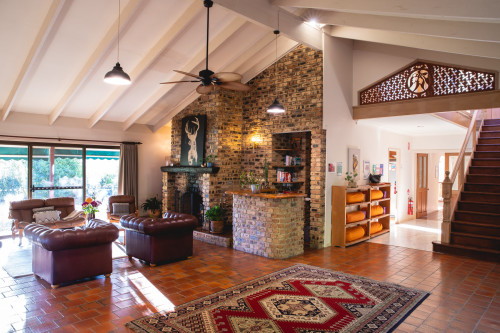
Care at The Buttery – Binna Burra
The Buttery’s Binna Burra campus is an adult residential therapeutic community in the Byron Bay hinterland of New South Wales, Australia. Located at 346 Lismore Road on Bundjalung Country, it provides a structured setting for people seeking help with alcohol and other substance-use problems. The current official program is built around community participation, counseling, education and practical preparation for life afterward. This profile reflects that service rather than the short private-retreat description still found in an older secondary listing.
The distinction changes several important expectations. The current Binna Burra residential programs can accommodate up to thirty-three people, bedrooms are shared with someone of the same gender, and the therapeutic community has a course measured in months. The provider also offers self-funded Private Access beds within this model. Private Access is an admission and funding route into the therapeutic community; it should not be confused with an exclusive villa, a guaranteed private bedroom or a separate twenty-six-day luxury package.
Who can apply to the residential program
The Buttery describes the therapeutic community as open to New South Wales residents aged eighteen and over. Its current FAQ expressly excludes under-eighteens from the residential service. The organization runs separate youth and community programs, but those should not be used to suggest that children can enter the Binna Burra therapeutic community. An adult considering admission should confirm eligibility with the intake team, particularly if they live outside the stated service area.
The substance-use scope includes alcohol, illicit drugs and prescribed medications that have become a problem. Suitability is assessed individually, including clinical needs and risk. A person may also have mental health concerns or other difficulties that need to be considered alongside substance use. That does not make the campus interchangeable with an acute psychiatric unit or with the organization’s separate specialist mental health services elsewhere in New South Wales.
Most people can refer themselves; a doctor’s referral is not generally required. The intake team may request relevant medical information as part of assessment. A relative can ask about the service, but the person seeking residential treatment needs to make contact and take part in the assessment themselves. This is a significant practical feature for families: gathering information on someone’s behalf is different from arranging an admission without that person’s participation.
How the therapeutic community works
The therapeutic-community model uses shared living and mutual support as part of treatment. Residents participate in a community environment alongside counseling, group therapy and education. The aim is to develop everyday skills, responsibility and a more workable way of relating to others. It is therefore different from a program organized entirely around private appointments or hotel-style hospitality. Willingness to engage with communal routines is an important part of assessing fit.
The current drug and alcohol service page describes three stages. The first twelve-week phase focuses on coping strategies and stabilizing wellbeing. A second twelve-week phase develops awareness of underlying relapse issues and consolidates learning. The final six-week phase addresses community reintegration and relapse prevention. The FAQ also summarizes residential participation as roughly three to seven and a half months, so the actual stage plan and expected dates should be confirmed at admission.
Moving through stages allows practical responsibilities and preparation for discharge to develop over time. A person should understand which stage they are entering, what participation involves and how readiness for the next step is reviewed. The published structure should not be read as a guarantee of a particular result after a set number of weeks. It provides the framework within which the individual and community work take place.
The Buttery describes both individual and group counseling, with psychoeducation, case management and community activities. Its current core program pages do not promise one named psychotherapy for every resident. A prospective participant can ask which professional support is available for their particular needs and how concerns are raised during the stay. A therapeutic community’s shared framework should still leave room for individual assessment and appropriate clinical decisions.
Daily structure and participation
The published daily routine begins with physical activity and ordinary tasks of daily living. Groups run broadly from 8:45 a.m. to 4 p.m., combining therapy, education, case management and activities. Evenings may include a house meeting, a twelve-step meeting or free time. This is a structured residential course rather than an unplanned retreat, and the timetable should be considered alongside the person’s ability to participate.
Activities listed by the provider include yoga, meditation, gardening, choir, art and exercise, with outings to places such as beaches, parks or the cinema. They provide different ways to take part in community life and the treatment day. Their inclusion does not imply that every activity is available on every day or that a specific outing is guaranteed. The team can explain how activities change across the stages and how physical or other individual needs are accommodated.
Residents are encouraged to attend twelve-step meetings. That is a stated element of the community’s recovery environment, rather than an optional detail that should be omitted from a comparison with other approaches. Someone who has previous experience of peer-support groups can discuss it during assessment. The practical question is how meetings fit with counseling, group work and the resident’s wider support plan.
Withdrawal needs and the opiate treatment pathway
The current residential information identifies beds for people on an opiate treatment program who wish to stabilize on, or consider withdrawal from, an opiate substitute. It states that prospective participants need to be on treatment and under medical supervision before admission. That requirement should be clarified with the intake team and current prescriber. The therapeutic community should not be treated as a place to arrive without a planned medication and medical-support arrangement.
The Buttery also describes community-based withdrawal management elsewhere in its broader drug and alcohol service, working with general practitioners. That is a different service context and should not be presented as proof of an acute detox unit at the Binna Burra campus. Someone who may require withdrawal management needs an agreed sequence identifying the appropriate setting, responsible clinicians and conditions for starting residential treatment.
The therapeutic community also has places associated with the MERIT referral pathway described by the provider. Legal or justice-system involvement does not remove the need for individual suitability assessment. The intake team can explain how a referral is considered and what information is needed. A place, admission date or particular legal outcome should not be assumed from the existence of the pathway.
Shared rooms and practical rules
The current FAQ says residents share a room with someone of the same gender. This replaces the older implication that a private room can be expected as part of a small private retreat. Shared bedrooms and communal areas make privacy, sleep, personal boundaries and household routines relevant subjects for the intake conversation. If a person has a specific access or health-related accommodation need, it should be discussed before accepting a place.
Residents cannot use mobile phones or laptops during the stay under the published rules. They also cannot keep their own vehicles on site, although temporary parking is available for arrival and departure. These conditions can be consequential for someone who expects to continue working remotely or travel independently during treatment. Plans for outside responsibilities should reflect the actual residential rules rather than assumptions based on a general rehabilitation label.
Pets are not permitted at the residential service, and the provider states there are no animals on site. The outdoor program therefore should not be described as an animal-assisted or pet-friendly residence. The setting offers space for community activities and outings, but the practical arrangements are those of a residential treatment community. Current information from intake is more reliable than transferring an amenity from another program or an older listing.
Family contact and support for relatives
The provider’s current rules restrict family visits during the first three months and allow visits in later stages in consultation with the case manager and community. Residents with dependent children have individualized family-contact arrangements discussed with their case manager. This distinction is important for parents planning a longer stay. The appropriate contact plan should be agreed before admission rather than assuming ordinary unrestricted visiting hours.
The Buttery’s Family, Carers and Friends Support program is separate support for people affected by a loved one’s substance use. Its current description includes individual face-to-face or telephone counseling, work on family dynamics, education and collaboration with Family Drug Support. It is provided without charge within its stated service area. Family members can therefore ask about their own support needs as well as the resident’s treatment.
Family counseling is not the same as permission to visit the residence at any time or automatic access to a participant’s clinical information. The purpose, consent and communication arrangements should be clear. Support for relatives can continue to be valuable even when the resident is focusing on the early community stages and direct visiting is limited.
Costs, Private Access and the waiting list
The current published living contribution is eighty-five percent of a full Centrelink benefit, or an equivalent amount for someone who does not receive that benefit. The program page explains this as a contribution toward food and accommodation, and the FAQ says the service is not covered by private health insurance. The actual amount and payment arrangements should be confirmed with intake. This is not the same pricing model as the older unverified USD 36,000 retreat estimate.
Self-funded Private Access provides a route for people able to pay an upfront fee for non-funded beds, with priority assessment and access described by the provider. The current FAQ refers to access for up to three months, but it does not publish a numerical tariff. The individual quote should explain what the payment covers, the expected stage of treatment and any continuing contribution. Paying privately should not be assumed to purchase a different clinical model or a private bedroom.
For other admissions, waiting times vary with the individual situation and available beds. The intake team can explain readiness requirements and likely next steps, but a fixed wait cannot be inferred from the website. Someone who has previously left treatment can reapply and be assessed again, with a place subject to the current process and availability. Planning should account for what support is needed while waiting.
Transition and contacting the intake team
The final stage emphasizes reintegration and relapse prevention. Eligible participants may apply for transitional housing in Byron Bay after the therapeutic-community course; access is not automatic. The wider organization also provides community-based programs, but their locations, eligibility and services differ. The discharge plan should identify the support that is actually available to the person, including housing, ongoing treatment and family or community connections.
The current intake number is +61 2 6687 1111, and the published email is [email protected]. Enquiries are handled during the stated business hours, with a phone assessment that can take up to an hour. The Australia treatment directory can help compare different residential models. The Buttery’s Binna Burra service is best evaluated as a structured adult therapeutic community, with its shared living, participation requirements, staged course and particular funding arrangements understood before admission.
Sources and verification
Current primary information reviewed October 20, 2026: The Buttery overview, therapeutic community and drug/alcohol services, residential eligibility, rules and costs, family support, and contact and campus address. The unclaimed secondary listing retains a conflicting twenty-six-day private-retreat description and price; those details are not used as current program facts.
Conditions
Levels of care
Settings
Treatment approach
Community participation, individual and group counseling, psychoeducation, case management, twelve-step meeting participation, practical skills, exercise, yoga, meditation, gardening, art and staged reintegration
Fees & admissions
Confirm current pricing
The current published contribution is eighty-five percent of a full Centrelink benefit, or an equivalent amount for a non-recipient, toward food and accommodation. Self-funded Private Access has an upfront fee that is not publicly quantified. No fixed numerical tariff is verified; the old USD 36,000 thirty-day retreat estimate is removed. The FAQ states private health insurance does not cover this service. Confirm the current contribution and Private Access terms directly.
Confirm the current program, duration, accommodation and included services directly with the center.
Contact intake on +61 2 6687 1111 or [email protected]. The applicant participates in a phone assessment of up to one hour; eligible NSW adults, clinical suitability, medication arrangements and waiting-list availability are assessed individually. Confirm shared-room needs, family-contact plan and funding route before admission.