About Houghton House — Randburg
Houghton House provides adult inpatient addiction treatment at 432 York Avenue in Randburg, Johannesburg. The main inpatient service combines medical detoxification where needed, psychiatric input, individual and group therapy, and a structured residential routine. This profile concerns the main treatment campus. Houghton House’s outpatient service, family support venue, and halfway-house arrangements are other parts of its wider care pathway and should not be treated as interchangeable accommodation at the same address.
The provider describes itself as both a rehabilitation facility and a licensed private psychiatric hospital, with a multidisciplinary approach to substance use and co-occurring mental health conditions. Its program is designed as a full-time commitment rather than a stay organized around normal working hours. The published standard inpatient duration is 30 days, with an extension to 42 days when clinically indicated and appropriately funded. A separate 14-day relapse program is described for former Houghton House patients who need readmission.
Assessment, detoxification, and the early stage
The medical detox page describes an in-house unit with daily doctor visits and continuous nursing supervision. Intake includes physical, psychological, and psychiatric assessment, a review of substance use and other conditions, and an individualized medication and monitoring plan. The purpose is to establish the person’s actual needs before they join the fuller therapeutic routine. Not every admission requires detoxification; someone already stabilized in another appropriate facility may be able to enter the rehabilitation program directly.
The website often refers to an initial three-day medical-unit phase, but its FAQ also says the duration depends on the substance, pattern of use, and doctor’s assessment. Three days should therefore not be treated as a promised completion time for withdrawal. The provider states that detox is part of the full inpatient program and is not offered as a stand-alone short admission. A person seeking only withdrawal management should understand that program requirement before arranging a place.
Houghton House describes prescribed medication as part of withdrawal management when indicated. The public information does not establish one medication protocol for every substance or a universal policy on longer-term maintenance treatment. Someone already receiving prescribed treatment should discuss continuity with the medical team rather than assuming that every medication will be stopped or that a short detox course replaces ongoing care. The assessment should also identify when medical needs exceed what can appropriately be managed at this campus.
Integrated addiction and mental health treatment
The provider emphasizes treating substance use alongside mental health concerns within one coordinated plan. Its rehabilitation program describes psychiatric evaluation, psychological treatment, counseling, and practical recovery work. This may be relevant to someone whose substance use overlaps with anxiety, depression, trauma, or emotional regulation difficulties. A combined program should still identify the particular conditions being treated and how each will be assessed, rather than assuming every difficulty has the same cause.
The clinical team includes psychiatrists, psychologists, general practitioners, nurses, addiction counselors, social workers, occupational therapists, and biokinetic or exercise-related support. A dedicated case manager helps coordinate the process. For a prospective patient, this means the care plan can draw on different professional roles, but the allocation should be made concrete: who is the main therapist, which doctor oversees medication, and how often psychiatric review is planned for the person’s needs.
The therapy program and daily expectations
Houghton House lists cognitive behavioral therapy, dialectical behavior therapy, individual and group counseling, 12-step facilitation, trauma and grief work, psychoeducation, journaling, mindfulness, and exercise within its program. The daily structure is intensive. The website describes therapeutic activity across a day running approximately from 6 a.m. to 8 p.m., with meals and breaks included in the routine. That does not mean 14 hours of individual psychotherapy; it describes the overall framework of a highly structured inpatient day.
The different methods address different aspects of recovery. Cognitive behavioral work can examine habitual interpretations and actions, while dialectical behavior skills focus on managing emotions and difficult interactions. Psychoeducation provides language for understanding recurring patterns, and individual appointments allow more private concerns to be explored. Groups and 12-step work add a community component. The value of the combination depends on how the team adapts it to the patient, including their readiness, concentration, health, and prior treatment experience.
The provider describes primary care as the first 24 days and a secondary stage beginning around day 25, with greater family contact and interaction beyond the initial protected routine. These are its internal program stages, not evidence that every patient progresses at the same rate. The clinical plan should explain when more independence is appropriate and what skills or stability are needed before the person returns to a less supervised setting.
Named staff and clinical coordination
The current team page identifies Dan Wolf and Alex Hamlyn as directors, with roles in intake, clinical-program oversight, family support, and supervision. It lists psychiatrists Dr. Ajay Makan and Dr. Zaheeda Ebrahim Iqbal, whose published interests include substance dependence and associated mental health conditions. It also identifies Rejoice Gumbi as matron and Danelle Smit as facilities manager with a nursing background. These are provider-published roles; the actual treating professionals should be confirmed during admission.
The same page describes psychologists and social workers contributing to assessment, groups, individual therapy, and continuing-care plans. For example, clinical psychologist Reginald Mahlatjie is described as working on addiction, emotional regulation, trauma, and relapse prevention, while social worker Aasiyah Mia discusses family sessions and coordination with outpatient and halfway-house services. These details illustrate how the program links clinical work with practical planning, without implying that every named person will participate in every patient’s treatment.
Family contact and a separate support program
The family information page says a family therapy session is arranged within the first seven days of admission. It also sets limits on ordinary contact during that initial period: no phone calls or visits in the first week, followed by three calls a week from day eight and approved weekend visits. The published visiting windows are Saturday afternoon and Sunday late morning through afternoon, with a maximum of two hours per day. Arrangements should be reconfirmed with the treating team.
Houghton House also offers a weekly family support meeting at 420 York Avenue, Ferndale, known as First Step, a different address from the main inpatient campus. The published meeting is on Thursday from 5:30 to 7 p.m., with a listed fee of ZAR 100 per person. It is open to people affected by a loved one’s addiction even when that person is not in treatment. The group combines education, discussion, and support, rather than functioning as a routine visiting session with an admitted patient.
The family page explicitly says Houghton House treats adults only. A family seeking care for someone under 18 should not infer adolescent eligibility from the organization’s wider family-support resources. Within adult treatment, family involvement should also respect the patient’s consent and clinical plan. A support meeting for relatives can address their own boundaries and wellbeing even when the patient’s therapy needs remain separate.
Accommodation and practical life on the main campus
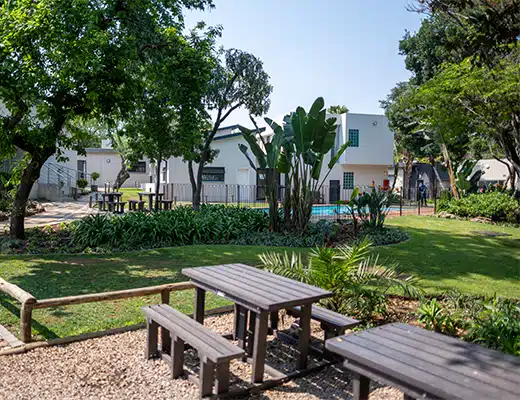
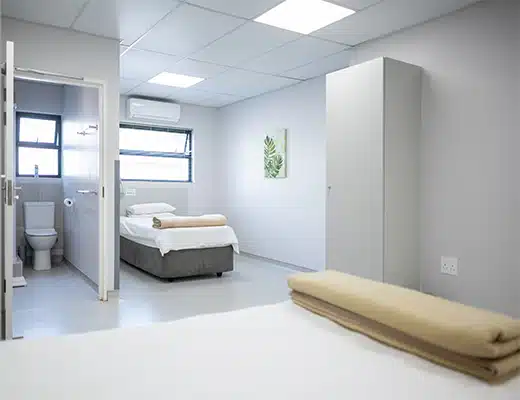
The official campus gallery provides a view of the residential environment, including communal and outdoor spaces. Earlier verified listing material showed shared-bedroom accommodation; a private room is not established as the standard offer. The inpatient page describes home-cooked meals approved by a registered dietitian, 24-hour security, and continuous nursing support. Room occupancy, bathrooms, mobility access, and any individual accommodation needs should be confirmed for the actual placement.
The provider says patients cannot continue normal work during inpatient treatment. Limited access for genuinely urgent matters may be considered, but it must not compromise the program. This is a meaningful difference for someone comparing Houghton House with a flexible outpatient or executive retreat model. Arranging leave, childcare, and other responsibilities in advance helps make the intensive schedule feasible, while the admissions team can explain how essential communication will be handled.
Published costs and medical-aid arrangements
The current rehabilitation-program page gives a typical 30-day inpatient cost of ZAR 92,000 to ZAR 102,000. This is a provider-published range, not an individualized final quote. The website also identifies a once-off ZAR 1,850 admission fee and, on the program page, possible medication copayments. A written estimate should clarify whether each of these is included in the proposed total and how an extension, additional treatment, or a change in funding affects the amount payable.
The medical-aid page describes extensive scheme coverage and says the admissions team manages benefit verification and preauthorization. Its broad coverage statements should be reconciled with the individual member’s available benefits and the more specific references to medication costs elsewhere on the site. This profile does not promise that every patient or insurer will fund the same stay. Obtain written confirmation of the authorized days, charges, exclusions, and any personal payment before admission.
Aftercare and the next level of support
The aftercare program is open to people who have completed inpatient treatment or the intensive outpatient program. It is described in phases with a decreasing time commitment and is recommended by the provider for at least the first year of recovery. A personalized plan may include a weekly 50-minute individual session, counseling groups, education, and recovery meetings. The published requirements include three evening aftercare sessions, two AA or NA meetings a week, and agreement to random testing.
Those expectations make aftercare a substantive commitment, not simply an occasional alumni call. The location, timetable, cost, and suitability for someone returning overseas should be resolved before discharge. The provider also offers halfway-house support for people who need a more structured transition, with work or study during the day and a supervised substance-free residence afterward. That is a distinct stage requiring its own assessment and arrangements, rather than an automatic extension of a bed on the main campus.
Houghton House is most suitable to evaluate as an intensive adult inpatient program with medical and psychiatric input, a strong group and 12-step component, and several possible continuing-care routes. The decision should turn on clinical suitability, the willingness and ability to participate in the structured routine, the agreed funding, and a practical plan for the next stage. Its published program offers useful detail, while individual outcomes and the exact course of treatment remain personal rather than guaranteed.
Reviewed October 20, 2026 using Houghton House’s official inpatient, rehabilitation, detox, team, family, facilities, funding, and aftercare information. Fees and operating descriptions are attributed to the provider. Individual clinical suitability, professional allocation, accommodation, and insurance benefits require confirmation.
Destinations
Conditions
Levels of care
Program approach
CBT, DBT skills, individual and group counseling, 12-step facilitation, trauma and grief work, psychoeducation, family work, and adapted exercise
Fees & admissions
ZAR 92,000–102,000 / program
Provider-published typical 30-day inpatient cost is ZAR 92,000–102,000. Site also lists a ZAR 1,850 admission fee and possible medication copayments; obtain written inclusions and individual scheme authorization. Extensions and later care require separate confirmation. Checked October 20, 2026.
Confirm the current program, duration, accommodation and included services directly with the center.
Adults only. Full-time inpatient commitment with individual clinical assessment; detox is part of the complete program, not a stand-alone admission. Confirm medical suitability, current medication plan, room, family contact, and written medical-aid authorization.